
ChatGPT now handles over 2.5 billion prompts a day, and a large share of that usage comes from businesses using it for support, content, and sales workflows. If you’re weighing ChatGPT integration for business use, the real question isn’t whether the technology works it’s whether you integrate it through the API yourself or bring in an OpenAI API integration company to do it properly, securely, and fast.
At GoodWork Labs, a Bangalore-headquartered technology company with over a decade of engineering experience, we’ve helped enterprise and mid-market clients move from “let’s try ChatGPT” to production-grade AI systems that actually move business metrics. This guide breaks down the use cases, the integration paths, the costs, and the checklist you need before you commit.
What Is ChatGPT Integration for Business?
ChatGPT integration for business means embedding OpenAI’s language model into an existing product, website, or internal workflow so it can answer questions, draft content, or automate repetitive tasks without a human doing it manually each time. It’s typically done through the OpenAI API, a pre-built plugin, or a custom-built application layer that connects ChatGPT to your own data and systems.
Why Should Businesses Integrate ChatGPT in 2026?
Businesses integrate ChatGPT to cut response times, reduce repetitive workload on staff, and personalize interactions at a scale humans can’t match alone. Beyond efficiency, generative AI has become part of how customers discover brands in the first place being genuinely useful inside a chat experience now doubles as visibility in an AI-driven search landscape.
Three business areas consistently see the fastest returns:
- Customer service : A 24×7 assistant that resolves routine queries and books appointments, freeing human agents for complex cases.
- Content creation : drafts, product descriptions, and social copy produced at speed, with human editors focused on strategy rather than first drafts.
- Lead generation : conversational chatbots that qualify and nurture website visitors, lifting conversion rates through personalization.
Sephora’s Virtual Beauty Assistant is a well-known example: a ChatGPT-powered recommendation engine that personalizes product suggestions based on stated preferences, which improved both the customer experience and sales.
What Are the Best ChatGPT Business Use Cases by Department?
Customer Support Automation
A ChatGPT-based assistant can triage tickets, answer FAQs, and escalate only what genuinely needs a human typically cutting first-response time from hours to seconds.
Marketing and Content Operations
Content teams use ChatGPT to keep publishing calendars full blog drafts, ad variations, and email copy while human writers focus on positioning, voice, and quality control.
Sales and Lead Qualification
On-site chatbots built on ChatGPT can qualify inbound leads in real time, capture intent signals, and route warm prospects directly to sales reps.
Talk to GoodWorkLabs’ AI engineers about the right integration path for your
business, no commitment required.
How Do You Integrate ChatGPT Into Your Business?
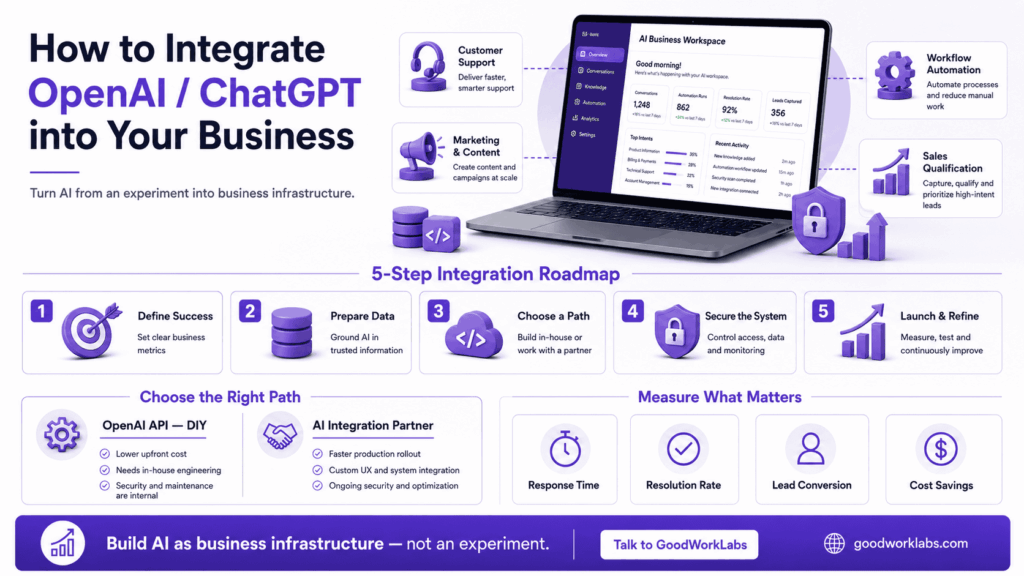
Integrating ChatGPT into a business is a five-step process: define success metrics, prepare your data, choose an integration path, secure the implementation, and then optimize continuously.
- Define success metrics. Decide upfront whether you’re measuring customer satisfaction, cost savings, or lead conversion this determines how you build and test the system.
- Collect and prepare data. ChatGPT performs best when it’s grounded in your own product information, support transcripts, and marketing material, not generic training data alone.
- Choose your integration path. Use the OpenAI API directly if you have in-house engineering capacity, or partner with an AI/ML advisory and development team for a managed build.
- Secure the implementation. Review OpenAI’s data handling practices and apply your own access controls, encryption, and audit logging around any sensitive data the assistant touches.
- Train, launch, and refine. Fine-tune prompts and responses against your brand voice, then monitor real conversations to catch gaps before they become customer complaints.
Should You Use the OpenAI API Directly or Hire an AI Integration Partner?
Use the OpenAI API directly if you have dedicated engineering resources and a narrow, well-defined use case; hire an AI integration partner if you need production-grade reliability, security review, and ongoing optimization without building an internal AI team from scratch.
| Factor | OpenAI API (DIY) | AI Integration Partner (e.g. GoodWorkLabs) |
|---|---|---|
| Setup speed | Slower — requires in-house development cycles | Faster — dedicated team, proven process |
| Customization depth | High, but limited by internal skill level | High, with fine-tuning and UX design included |
| Security & compliance | Your responsibility end-to-end | Built-in review and hardening |
| Ongoing maintenance | Falls on internal team | Managed as part of the engagement |
| Upfront cost | Lower (API usage fees only) | Higher initial investment, lower long-term risk |
What Are the Security Risks of ChatGPT Integration?
The biggest security risks in ChatGPT integration are exposing sensitive customer data to third-party processing, weak access controls on the API layer, and insufficient monitoring of what the assistant is allowed to say or do. Before going live, confirm how data is stored and processed under OpenAI’s policies, and layer your own encryption, role-based access, and logging on top of it particularly for regulated industries like banking and finance.
How Do You Measure ChatGPT Integration Success?
Measure ChatGPT integration success against the metrics you defined at the outset response time, resolution rate, lead conversion, or cost savings and revisit them monthly. Run A/B tests on different prompt structures and collect direct user feedback; treat the first launch as a baseline, not a finished product, since ongoing tuning is what separates a chatbot that helps from one that frustrates customers.
Conclusion: Making ChatGPT Integration for Business Work Long-Term
ChatGPT integration for business isn’t a one-time technical task it’s an ongoing capability that pays off when it’s tied to clear metrics, real customer data, and continuous refinement. Whether you build it in-house through the OpenAI API or bring in a partner, the businesses seeing the biggest gains are the ones treating this as infrastructure, not an experiment.
GoodWorkLabs has spent over a decade building AI, mobile, and software solutions for enterprise clients across banking, retail, and manufacturing. Our AI engineering team handles the API development, data security, and UX design needed to take ChatGPT from a demo to a dependable part of your business.
GoodWorkLabs’ AI experts will assess your needs and map an integration plan
built for your business.