
Cross-platform application development is the practice of writing a single codebase that runs on both iOS and Android, instead of building and maintaining two separate native apps. It has moved from being a budget workaround to becoming the default approach for most businesses in 2026, and the reasons go well beyond simply saving money. This article breaks down the benefits of cross-platform application development that actually move the needle for a business cost, speed, maintenance, talent, and ROI backed by current industry data rather than generic claims.
What Are the Real Business Benefits of Cross-Platform Development?
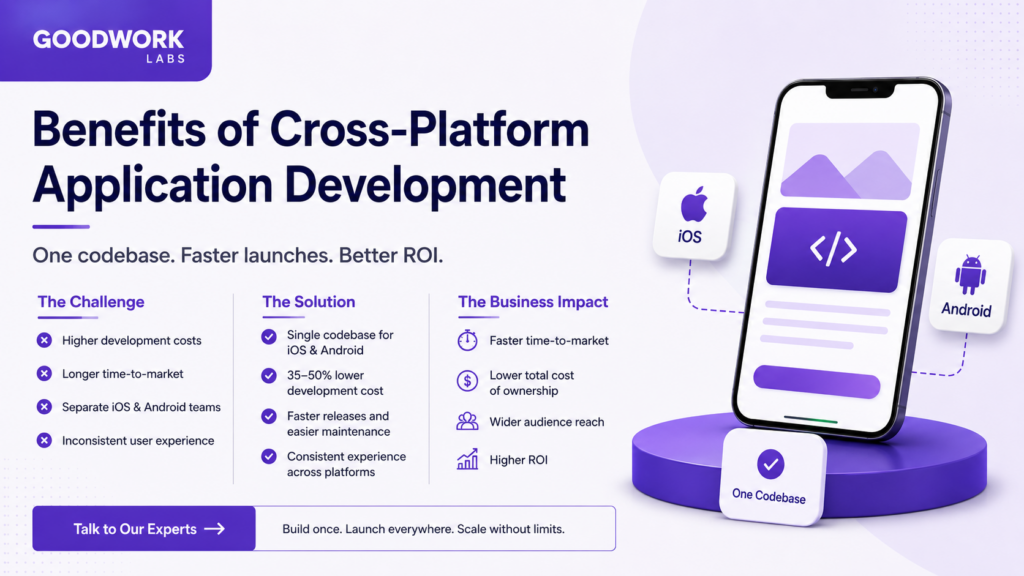
The real benefits are lower total cost, faster time-to-market, simpler long-term maintenance, broader simultaneous audience reach, easier hiring, and consistent feature parity across platforms. These aren’t isolated perks they compound, since a smaller team working from one codebase naturally builds faster, costs less to maintain, and rolls out updates to every user at once.
Enterprises like Netflix and BMW have standardized parts of their mobile strategy on cross-platform frameworks for exactly this reason, treating it as a strategic efficiency layer rather than a cost shortcut. The sections below break down each benefit individually, with the evidence behind it.
How Much Can Cross-Platform Development Reduce Your Total Development Cost?
Cross-platform development typically cuts total development cost by 35 to 50% compared to building two separate native apps, primarily because one team can replace what would otherwise require two specialized teams. Where a native project might need four to six developers split across iOS and Android, a cross-platform build can often be handled by two to four specialists working from a shared codebase.
This isn’t just a one-time build saving either smaller teams mean lower ongoing payroll, fewer people to coordinate across releases, and less duplicated QA effort every time a feature ships. For startups and SMEs working with fixed budgets, this cost structure is frequently the deciding factor in choosing cross-platform over native from day one.
How Does Cross-Platform Development Speed Up Time-to-Market?
Cross-platform development speeds up time-to-market by letting teams build, test, and ship one codebase instead of coordinating two parallel native builds. Some cross-platform migrations have delivered as much as a 70% reduction in development cycle time, and companies that share the bulk of their codebase across platforms have moved from monthly to weekly release cycles.
Airbnb’s engineering team, for example, shifted a large share of its mobile codebase to a shared architecture and significantly accelerated how often it could ship updates without sacrificing the native feel of the app. For any business where being first to market with a feature matters, this compounding release speed is a genuine competitive advantage, not just a development convenience.
Curious what cross-platform could save your specific project? Let’s run the numbers together.
How Does a Single Codebase Make Long-Term Maintenance Easier?
A single codebase makes long-term maintenance easier because most bug fixes, feature updates, and design changes only need to be written and tested once, then deployed to both platforms simultaneously. Modern cross-platform frameworks now share roughly 80 to 95% of business logic and 60 to 90% of UI code across iOS and Android, leaving only a small platform-specific layer to maintain separately.
This matters most after launch, when most of an app’s lifetime cost is actually spent. Businesses maintaining a cross-platform app avoid the common native-app problem of a fix or feature landing on one platform weeks before the other, which otherwise creates inconsistent user experiences and support overhead.
How Does Cross-Platform Development Help You Reach a Wider Audience Simultaneously?
Cross-platform development lets you launch on iOS and Android at the same time, rather than staggering releases, which can effectively double your initial user acquisition opportunity. This matters because iOS and Android audiences behave differently iOS users tend to generate higher average revenue per user in developed markets, while Android commands significantly greater global user volume and a simultaneous launch captures both revenue patterns from day one.
Staggered native launches force a business to choose which platform to prioritize first, often delaying access to an entire segment of paying users for months. For consumer apps competing for early market share, that delay can be the difference between capturing user attention and losing it to a competitor who launched everywhere at once.
Why Is Access to a Larger Developer Talent Pool a Hidden Benefit?
Access to a larger developer talent pool is a hidden benefit because Flutter and React Native both have large, active, and growing developer communities, making hiring and replacing team members considerably easier than sourcing specialized native iOS and Android engineers separately. Recent developer survey data shows Flutter and React Native are now among the most widely used frameworks by professional developers, with both continuing to gain share among developers newer to the field.
This translates directly into lower hiring risk for businesses: a smaller, cross-platform-skilled team is easier to staff, onboard, and scale up or down as a project’s needs change, compared to maintaining two separate specialist teams that rarely overlap in skill set.
How Does Cross-Platform Development Ensure Consistent Feature Parity Across Platforms?
Cross-platform development ensures consistent feature parity because a single build and release process pushes the same features, fixes, and UI changes to iOS and Android at the same time. This eliminates the common native-development problem where Android users wait weeks for a feature that iOS users already have, or vice versa.
Feature parity isn’t just a technical nicety it directly affects brand perception and support load. Users comparing notes with friends on a different platform expect the same experience, and inconsistent rollouts generate avoidable support tickets and negative reviews that a unified release cycle largely prevents.
What ROI Can Businesses Realistically Expect from Cross-Platform Application Development?
Businesses can realistically expect positive ROI from cross-platform development within months for new builds, particularly for apps expecting more than 50,000 users or a development timeline of six months or longer. Smaller, simpler apps expecting under 10,000 total users may not see the same overhead-justifying returns, since the relative savings shrink as project scope shrinks.
The clearest ROI driver is avoided duplication: one team, one release pipeline, and one shared bug backlog instead of two of each. For most growth-stage businesses, this translates into a faster payback period on the initial development investment than an equivalent dual-native build would deliver.
Why Should You Partner with a Custom Mobile App Development Service for This?
Partnering with a custom mobile app development service matters because realizing these benefits in practice depends on framework selection, architecture decisions, and platform-specific polish that most in-house teams don’t handle daily. A generic template approach can capture some of the cost savings, but it rarely captures the maintenance and feature-parity advantages without deliberate architectural planning from an experienced team.
Working with a specialized custom mobile app development service also means these decisions get made once, correctly, rather than being revisited mid-project after a costly false start. This is where the theoretical benefits above turn into a working, profitable app rather than a stalled build.
See how these benefits apply to your specific product before committing a budget.
Conclusion: The Benefits Compound When You Execute Cross-Platform Right
These advantages aren’t a single benefit they’re a set of compounding efficiencies that stack on top of each other across the life of a product. Lower cost enables faster hiring, faster hiring enables faster releases, and faster releases keep every platform in feature parity, which in turn protects the ROI a business set out to capture in the first place. For most startups, SMEs, and even large enterprises, this is why cross-platform has become the practical default rather than a compromise. Getting the full value out of it, though, still depends on choosing the right framework and the right Mobile App Development Services partner to execute it well from day one.
Ready to see what cross-platform could do for your business?