
Most founders don’t reject staff augmentation for startups on principle, they get the timing wrong. It either feels like overkill for a five-person team, or it only gets considered after a launch date has slipped. The real question isn’t whether augmented talent works for early-stage companies; it’s recognizing the specific moments, post-funding scale-ups, locked launch windows, MVP sprints, sudden skill gaps,when bringing in external engineers becomes the smarter move than waiting out a full hiring cycle. This guide walks through those signals directly, and where the model fits inside Bangalore’s broader talent solutions landscape.
What Is Staff Augmentation for Startups?
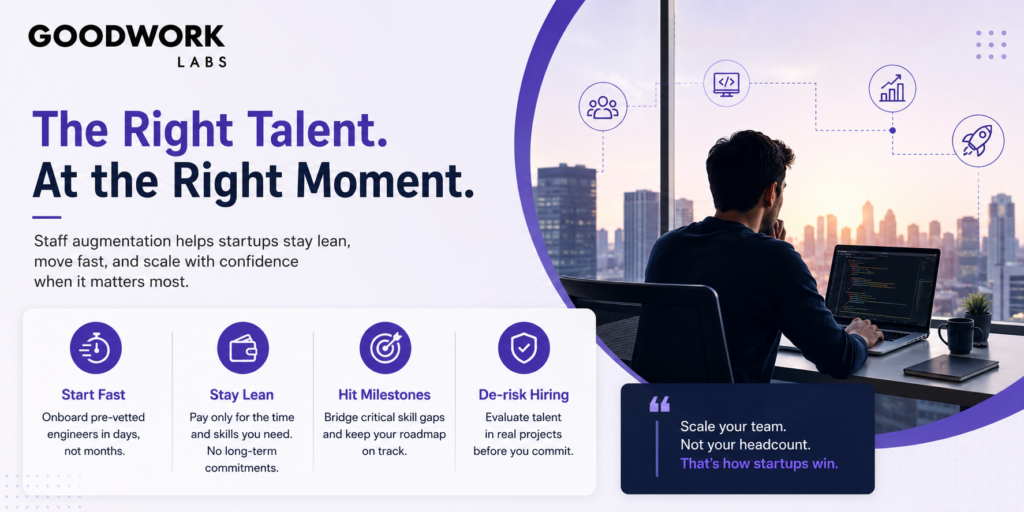
It means adding pre-vetted external developers to your existing team, under your direction, without permanent payroll. The engineer reports into your sprint cycle and uses your tools, while a partner handles employment, compliance, and replacement. It differs from outsourcing a whole deliverable, you keep control over priorities and code quality. This matters for a startup because most early hiring needs are genuinely temporary, even when they feel permanent. The model lets a five-person team behave like fifteen for exactly as long as a project demands, then scale back without severance or layoff complexity.
Why Does Timing Matter More for Startups?
Every hiring decision is measured against a finite, ticking runway rather than an annual budget. A mistimed hire at a pre-seed startup can consume two months of cash meant for validation. Indian VCs have grown notably burn-conscious since 2022, expecting 18 to 24 months of post-funding runway with efficient, declining burn, so every engineering cost has to earn its place. A full-time developer hired before a role’s permanence is proven locks in fixed cost against a shrinking runway. Staff augmentation removes that lock-in, matching headcount to the next six months instead of a year-out guess.
Signal #1: You Just Closed a Funding Round
The clearest trigger is the weeks after a round closes, when the board expects velocity but internal recruiting can’t keep pace. Direct hiring in Bangalore realistically produces two to four quality offers a month; doubling a team in a quarter isn’t possible that way without augmentation closing the gap. Reserve full-time hiring for three or four anchor roles, and use augmented engineers for the surge, strong hires convert to permanent later, while the rest scale back if milestones shift. See our full staff augmentation vs. full-time hiring guide for the decision logic.
Signal #2: A Launch Date Is Locked, Headcount Isn’t
When the ship date isn’t moving but you’re two engineers short, that’s a clear moment to bring in IT staffing services Bangalore rather than restart a direct search. A full-cycle hire sourcing, interviews, notice period, onboarding typically runs 60 to 90 days; few launch windows survive that. This is an opportunity-cost call: a missed launch costs more in lost investor confidence than any rate premium on contract talent. Ask a partner to commit to a placement date for your stack if they can’t, their bench isn’t ready.
Deadline locked and short on engineers?
Talk to GoodWork Labs About Staff Augmentation →
Signal #3: You’re Validating an MVP
Committing a permanent salary before knowing if an idea survives the quarter is usually the costlier mistake. The median time between seed and Series A has stretched to roughly 616 days in 2026, stretching runway pressure further and making capital discipline non-negotiable. This model fits the stage precisely: staff exactly what the hypothesis needs and walk away cleanly if it doesn’t progress. Price against the minimum team needed to validate, not the team you’d need if it succeeds. See exact figures in our staff augmentation cost in Bangalore breakdown.
Signal #4: A Key Engineer Just Left
India’s IT attrition has settled around 13 to 15 percent in 2026, so a sudden resignation isn’t rare, it’s worth a standing plan. The instinct to panic-hire a permanent replacement under pressure typically produces a worse long-term fit than a calmer search. An offshore staff augmentation India partner can stabilize the project within one to two weeks while your team runs a proper full-time search at a normal pace. If this repeats, a standing talent solutions arrangement beats treating each resignation as a fire drill.
Signal #5: You’re Missing a Specific Skill
Startups often hit a wall where the founding team can build the core product but lacks one skill a milestone requires DevOps before a scaling event, AI/ML to ship a model, security before an audit. Hiring permanently for a skill needed intensely for three months is a poor match for a lean cap table. This works here as a precision tool: bring in exactly the specialist a milestone requires, for exactly as long as needed, without reshaping your org chart around a temporary gap.
Augmentation or Full-Time: A Quick Framework
The fastest test: is the need durable for 12+ months, or tied to a milestone? Identity-defining roles justify full-time hiring despite higher cost, since institutional knowledge compounds over years. Milestone-bound needs almost always favor augmentation, since scaling down cleanly outweighs the marginal savings of a permanent salary on a temporary need.
| Startup Situation | Better Fit |
|---|---|
| Just closed a funding round | Staff augmentation + parallel core hires |
| Launch date locked, short on engineers | Staff augmentation |
| Validating an MVP, scope uncertain | Staff augmentation |
| Key engineer resigned mid-sprint | Staff augmentation, while you search properly |
| Founding engineer or long-term architect | Full-time hiring |
Choosing an IT Staffing Services Bangalore Partner
For a startup, the right IT staffing services Bangalore partner looks different from one built for enterprise procurement. Speed matters more than brand pedigree, ask for a committed placement date rather than a general timeline, and avoid providers requiring long lock-ins or large retainers that work against a lean runway. Confirm the partner has actually worked with early-stage companies and that contract-to-hire is genuinely available for roles that may later prove permanent.
How Offshore Staff Augmentation India Changes the Cost Equation
Offshore staff augmentation India changes a startup’s unit economics, since Bangalore-based talent typically delivers significant savings versus equivalent US or European roles while maintaining comparable depth extending runway by months without cutting scope. The deeper advantage is avoiding full cost of employment entirely: an offshore augmented engineer starts producing in one to two weeks, with compliance already handled by the vendor, making it one of the biggest levers available without touching headcount plans.
Conclusion: A Timing Decision, Not a Default
Staff augmentation for startups isn’t universally right, it’s right at specific moments and the wrong default at others. Founders who use it well tie it to funding milestones and skill gaps, not panic once a deadline is already at risk. Get the timing right, and augmented talent lets a six-person team ship like sixteen exactly when it matters, then scale back cleanly when it doesn’t.
For the full operating model once you’ve decided to move, see our IT Staff Augmentation Services in Bangalore strategic guide. If speed is the binding constraint, see our guide to hiring developers in Bangalore fast.
Not sure if now is the right time for your startup?
Book a Free Strategy Call →