
Cross-platform development lets you build one app that runs on both iOS and Android from a single codebase, using frameworks like Flutter or React Native. It’s the default starting point for most startups and business apps in 2026, but knowing it exists isn’t the same as knowing how to use it well. This guide is a practical walkthrough: which apps it suits, how to pick a framework, what it costs, how long it takes, and how to avoid the mistakes that derail most first-time cross-platform app development projects.
What Types of Apps Are Best Suited for Cross-Platform Development?
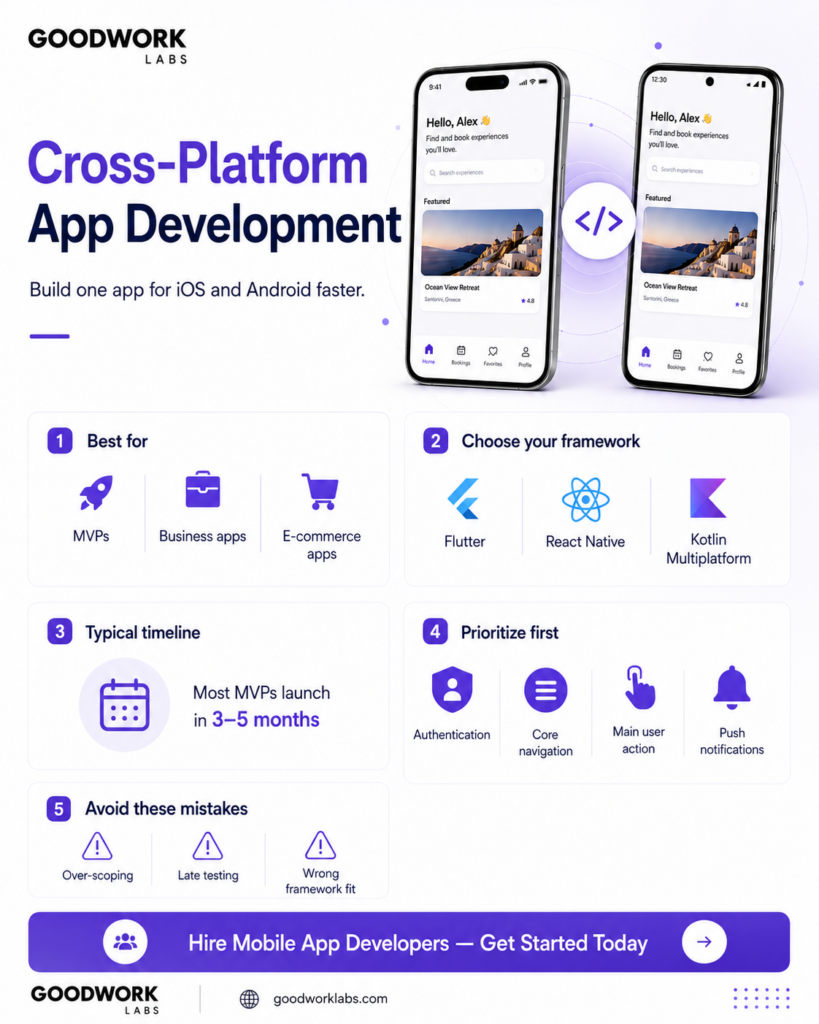
Cross-platform development is best suited for MVPs, content-heavy apps, and products where launching on both iOS and Android quickly matters more than squeezing out every millisecond of device-level performance. Startups testing a new idea, businesses launching a booking or loyalty app, e-commerce and marketplace apps, and internal enterprise tools all fall into this category.
These apps share a common thread: their core requirements are screens, forms, APIs, search, and notifications things that translate cleanly across a shared codebase. If your roadmap looks like this, cross-platform will get your product to market faster without users noticing a meaningful trade-off in day-to-day use.
Which Cross-Platform Framework Should You Choose?
Choose Flutter if you want pixel-perfect custom UI, heavy animation, and a consistent brand look across platforms; choose React Native if your team already has web or React expertise, or you’re building a content-heavy, text-driven app. Flutter now holds close to half of the cross-platform market and compiles Dart directly to native ARM code for smoother rendering, while React Native’s newer architecture has eliminated the old bridge bottleneck that once caused animation lag.
Kotlin Multiplatform is a third option worth knowing about it shares business logic across platforms while keeping a fully native UI layer, which appeals to teams that want code reuse without giving up native-feeling screens. The right pick ultimately comes down to your team’s existing skills and how visually ambitious your app needs to be.
How Much Does Cross-Platform Development Typically Cost?
Costs vary widely based on feature complexity, but a simple MVP with core screens, authentication, and basic backend integration is one of the more affordable ways to get a working product into users’ hands. Costs scale up with catalog size, custom animations, third-party integrations (payments, maps, CRM), and any AI or personalization features layered on top.
Because one codebase covers both platforms, you’re paying for a single development and QA cycle rather than two, which is where most of the cost efficiency comes from compared to building separate apps. Getting an accurate number for your specific project requires scoping your exact feature list with a development partner rather than relying on a generic price range.
Get a clear cost and timeline estimate for your specific app no generic price ranges.
How Fast Can You Launch an MVP with Cross-Platform Development?
Most MVPs built with cross-platform frameworks launch in 3 to 5 months, depending on how many features and third-party integrations are involved. This speed comes directly from writing and testing one codebase instead of two separate native builds, which also means faster iteration once real user feedback starts coming in.
Speed matters most at the validation stage, when the cost of being wrong about a feature is still low. A team that ships a cross-platform MVP in under five months and starts gathering real usage data is in a stronger position to make its next roadmap decision than one still deep into a longer build with no market feedback yet.
What Features Should You Prioritize in a Cross-Platform App Build?
Prioritize authentication, core navigation, your primary user action (booking, checkout, search, or content feed), and basic push notifications before anything else these are the features that make an app usable, and they’re also the ones that translate most cleanly across a shared codebase. Nice-to-have features like advanced animations, AR elements, or deep personalization should come after the core flow is solid and tested.
This sequencing matters because it’s far easier to test and validate a simple, working core than to debug a feature-heavy app all at once. Teams that try to launch everything simultaneously tend to spend more time fixing integration issues than teams that ship a focused first version and expand from there.
What Are Common Mistakes to Avoid When Building Cross-Platform?
The most common mistake is treating both platforms as identical when scoping the project iOS and Android still have different design conventions, permission flows, and app store review processes that need separate attention even within a shared codebase. Skipping platform-specific testing until the very end is a close second, since issues that seem minor on one OS can block your entire app store submission on the other.
Other frequent missteps include over-scoping the first release, choosing a framework based on trends rather than your team’s actual skill set, and underestimating the ongoing maintenance a shared codebase still requires as both iOS and Android push OS updates every year. Planning for these upfront avoids costly rework later.
Why Work with Professional Mobile App Development Services for Your Build?
Working with professional mobile app development services matters because framework selection, feature sequencing, and platform-specific testing all have long-term consequences that are expensive to reverse once development is underway. An experienced partner can scope your specific feature list and team constraints upfront, rather than letting you discover gaps mid-project.
This is especially valuable for first-time app builders, since a team that has shipped multiple cross-platform apps in production already knows which features tend to need extra attention on iOS versus Android, and which third-party integrations are straightforward versus time-consuming. That experience typically saves more time than it costs.
How Do You Hire the Right Mobile App Developer for a Cross-Platform Project?
To hire the right mobile app developer for a cross-platform project, look for proven production experience in your chosen framework, a portfolio of shipped apps rather than prototypes, and clear communication about realistic timelines and trade-offs. Ask specifically about apps they’ve maintained post-launch, since ongoing maintenance reveals more about a developer’s skill than the initial build alone.
Whether you hire an individual specialist or a full team, prioritize experience with app store deployment, CI/CD pipelines, and long-term maintenance over pure build speed. If you plan to Hire mobile app developer talent for an ongoing product rather than a one-off MVP, this experience matters even more than it does for a short-term build.
Conclusion: Cross-Platform Works When You Execute It Right
This approach works best when you treat it as a full execution plan, not just a technology choice picking the right framework for your team, sequencing features sensibly, and testing both platforms properly from the start. For most startups and business apps, cross-platform app development remains the fastest, most cost-efficient way to get a working product in front of real users. Getting the execution details right is what separates apps that launch smoothly from ones that stall in review or need a costly rebuild and it’s exactly where the right mobile solutions partner earns their keep.
Ready to build? Work with a team that’s shipped cross-platform apps across industries.