
Mobile commerce now drives more than half of all global online retail sales, yet the average shopping app still loses roughly 85 out of every 100 shoppers who add an item to their cart. The gap between a shopping app that gets downloaded and one that consistently converts almost always comes down to a specific set of features not a longer feature list, but the right one. This guide walks through the features that separate high-converting shopping apps from the ones users delete within a week, and where each one fits into a modern E-commerce Mobile App Development roadmap.
What Makes a Shopping App “High-Converting” in 2026?
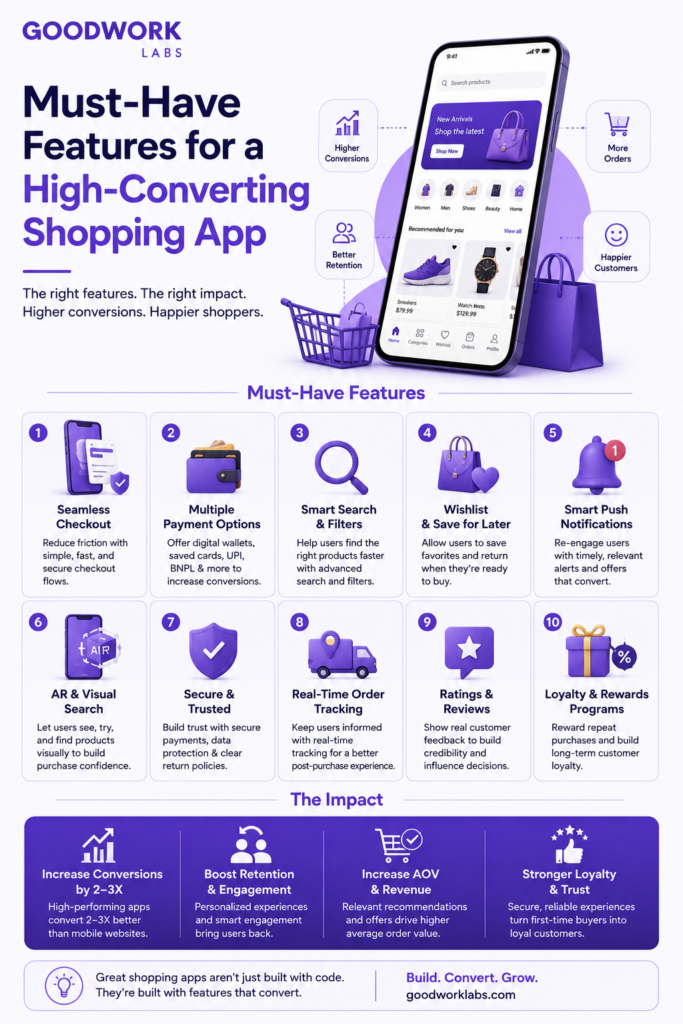
A high-converting shopping app is one that removes friction at every step between discovery and purchase, typically converting at 2 to 3 times the rate of a mobile website. This isn’t about adding more screens or more options it’s about making each screen do its job faster. Industry benchmarks show mobile apps converting between 3.5% and 4%, compared to roughly 2% for mobile-optimized websites, largely because apps store payment details, remember preferences, and cut out repeated logins.
The features covered in this guide aren’t cosmetic additions. Each one directly targets a specific point where shoppers abandon their journey slow load times, complicated checkout, irrelevant product suggestions, or a lack of trust signals at payment. Solving these individually is what compounds into a measurably higher conversion rate.
How Does One-Tap Checkout Reduce Cart Abandonment?
One-tap checkout reduces cart abandonment by removing the multi-step forms that cause most mobile shoppers to give up before paying. Mobile cart abandonment sits close to 85%, nearly 15 points higher than desktop, and checkout friction is consistently cited as a leading cause. When a shopping app stores card details, addresses, and preferred payment methods, the path from “Buy Now” to “Order Confirmed” can shrink to a single tap.
This is one of the most common gaps our team finds when auditing apps for clients as part of E-commerce Mobile App Development engagements checkout flows built years ago that still ask for the same information on three separate screens. Reducing checkout to 60 seconds or less, and showing total cost (including shipping and tax) earlier in the journey, are two of the highest-leverage fixes available to any team of mobile commerce app developers.
Why Is AI-Powered Personalization a Non-Negotiable Feature?
AI-powered personalization feature is essential because it directly increases both conversion rate and average order value by showing each shopper products they’re actually likely to buy. Brands using AI-driven recommendation engines report meaningfully higher revenue than those relying on static product grids, and predictive personalization has been shown to lift conversion rates by around 30%.
Personalization works best when it’s built into the app’s architecture from day one rather than bolted on later recommendation logic needs access to browsing history, cart behavior, and purchase patterns in real time. This is also where agentic AI is heading next: apps that don’t just recommend products but anticipate intent and act on it, such as auto-applying a saved size or restocking a frequently reordered item without the shopper searching for it again.
How Do AR and Visual Search Improve Purchase Confidence?
AR and visual search improve purchase confidence by letting shoppers see how a product looks or fits before they commit to buying it, which directly reduces returns. Data from fashion and beauty retailers shows shoppers are significantly more likely to complete a purchase after viewing a product in 3D or trying it on virtually, with some brands reporting purchase likelihood increasing by well over 50%.
These features matter most in categories where fit, color, or spatial sizing drive hesitation fashion, furniture, home decor, and beauty. Visual search, where a shopper photographs an item and the app finds similar products in the catalog, is becoming equally important as more product discovery starts on social media rather than inside the app itself. Building this level of camera and sensor integration is one of the more technical parts of E-commerce Mobile App Development, and it’s usually where experienced mobile commerce app developers add the most value over generic app builders.
What Payment Options Should a High-Converting App Support?
A high-converting shopping app should support three to five payment options that balance choice with simplicity digital wallets, saved cards, and at least one Buy Now Pay Later option for higher-ticket items. Digital wallets alone now account for more than half of all online payment transactions globally, making Apple Pay, Google Pay, and UPI-based options close to mandatory rather than optional.
BNPL integration deserves particular attention for mid-to-high value catalogs, since it directly addresses “sticker shock” at checkout one of the most common reasons shoppers exit at the final step. For teams offering Mobile app development services in Bangalore and other major tech hubs, integrating multiple regional payment rails (UPI, wallets, cards) alongside global options is now a standard part of scoping any retail app project.
How Does Push Notification Strategy Impact Retention?
Push notifications impact retention by bringing shoppers back into the app at the exact moment their purchase intent is highest, such as when a cart is abandoned or a wishlist item drops in price. Notifications sent within 48 hours of cart abandonment convert roughly three times better than delayed or generic messages, but poorly targeted notifications do the opposite they’re one of the top reasons shoppers uninstall retail apps.
The difference between a helpful notification and a spammy one comes down to context: “Your saved item just dropped in price” performs far better than a generic discount blast. Location and behavior-based triggers restock alerts, price drops, and delivery updates consistently outperform broad promotional pushes on both open rate and conversion.
Why Does App Speed and Performance Directly Affect Revenue?
App speed directly affects revenue because every 100-millisecond delay in load time measurably reduces conversions, and shoppers abandon slow-loading screens within seconds. Apps that improve their Core Web Vitals and loading performance have reported conversion increases ranging from 5% to over 30%, depending on how poor the starting performance was.
Performance issues are rarely visible in a feature list, which is why they get deprioritized but they quietly undercut every other feature on this page. A beautifully designed AR try-on tool or personalization engine won’t matter if the product page itself takes four seconds to load. Performance audits should be a standing part of any app’s maintenance cycle, not a one-time launch checklist item.
How Can Social Commerce Integration Drive Discovery-to-Checkout Sales?
Social commerce integration drives sales by collapsing the traditional funnel discover, browse, buy later into a single in-app action, since a large share of shoppers now discover products directly on social platforms. Social commerce is projected to reach well over two trillion dollars globally, and platforms like Instagram and TikTok now support native checkout and direct product tagging.
For a shopping app, this means supporting deep links from social platforms straight into a specific product page, rather than dropping users on a generic homepage. Shoppable video, live commerce events, and influencer-tagged product feeds are increasingly expected rather than experimental, particularly for fashion, beauty, and lifestyle categories where visual discovery drives the first click.
Why Should You Hire Custom Mobile App Development Services for These Features?
You should hire custom mobile app development services because conversion-critical features like secure checkout, payment gateway compliance, and real-time AI personalization require specialized expertise that most in-house teams don’t maintain full-time. A generic template or plugin-based build can get an app live quickly, but it usually can’t support the level of custom personalization logic or payment flexibility covered above.
An experienced partner also shortens the path from concept to launch, since the checkout flows, AR integrations, and notification systems described here have largely already been solved in prior projects. When you Hire Custom mobile app development services, you’re paying for that accumulated experience as much as for the code itself fewer false starts, and a feature set built around actual conversion data rather than guesswork.
Bringing It All Together
None of these features work in isolation a fast one-tap checkout still loses shoppers if the app is slow to load, and AI personalization still underperforms if payment options don’t match what the shopper prefers. The apps winning in 2026 treat conversion as a system: speed, trust, relevance, and simplicity, reinforcing each other at every screen.
For any brand investing in E-commerce Mobile App Development, the goal isn’t to build every feature at once it’s to sequence them based on where your specific drop-off points are highest, starting with checkout and performance before layering in AI, AR, and social commerce. Whether you’re evaluating in-house resourcing or looking to Hire Custom mobile app development services, this sequencing is what separates apps that quietly plateau from ones that keep compounding conversion gains month over month.