 AI & ML Advisory Services
 Software Development
 Staff Augmentation
 DevOps Consulting Services
 Digital Transformation
 Talent And RPO Solutions
 Artificial Intelligence
 UX Design Studio
 Robotic Process Automation
 Global Capability Center(GCC)
 Platform Strategy
 Cloud Services
 Mobile App Development
 Games Development
 IOT Application Development
 Corporate Training Services
Enterprise software priorities are evolving rapidly. In 2027, every competitive software development company is expected to deliver more than functional applications. Enterprise buyers now demand scalable architecture, intelligent automation, security-first engineering, and measurable ROI.
For CTOs, founders, product heads, and IT leaders evaluating a software development service, understanding technology trends is critical to selecting the right long-term partner.
This article explores the most important technology trends shaping every modern software development company in 2027, while highlighting how custom software development services are evolving to meet enterprise demands.
Why Technology Trends Matter When Choosing a Software Development Company
Selecting a software development company today is a strategic investment decision. Beyond cost considerations, enterprises evaluate:
-
Scalability and cloud readiness
-
Architecture resilience
-
Security and compliance maturity
-
AI and data capabilities
-
Long-term maintainability
-
ROI from custom software development
A forward-thinking software development service provider aligns engineering strategy with business goals. The trends below define what leading firms are adopting in 2027.
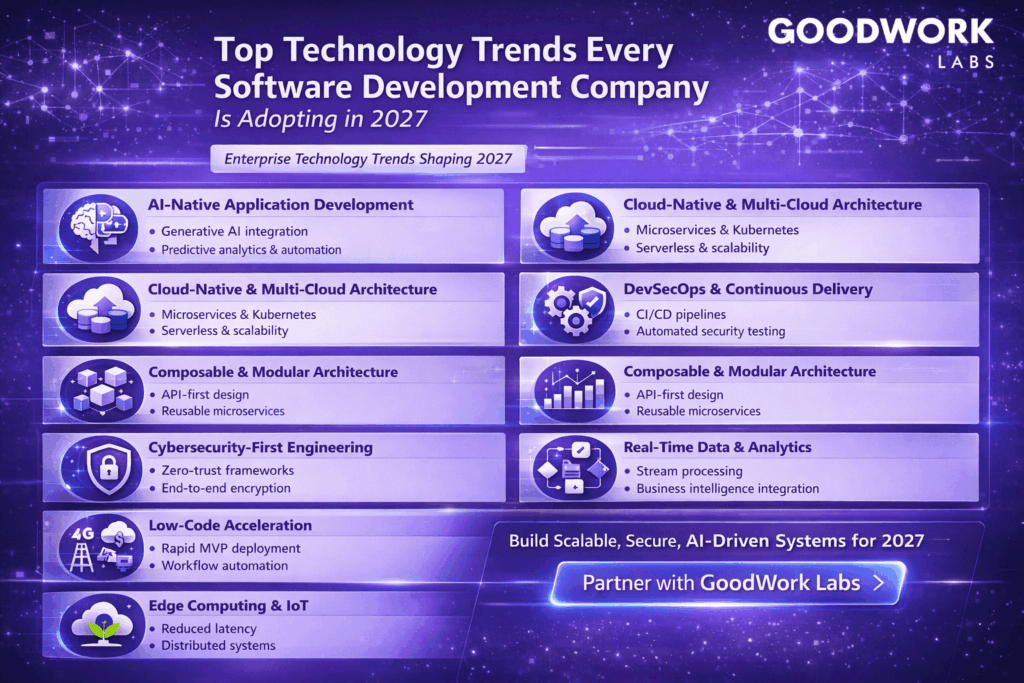
1. AI-Native Custom Software Development
Artificial intelligence has moved from experimentation to core infrastructure. In 2027, every enterprise-focused software development company integrates AI directly into system architecture.
Key Capabilities
-
Generative AI integrations for enterprise workflows
-
Predictive analytics engines
-
AI-driven customer personalization
-
Intelligent automation modules
-
Conversational interfaces powered by large language models
Instead of retrofitting AI, modern custom software development services design data pipelines and machine learning workflows from the start.
Business Impact
-
Improved operational efficiency
-
Enhanced decision-making
-
Faster data processing
-
Increased customer engagement
Enterprises looking for long-term competitive advantage increasingly prefer a software development company that specializes in AI-first systems.
2. Cloud-Native and Multi-Cloud Architecture
Cloud maturity has shifted from migration to optimization. In 2027, every scalable software development service builds systems using cloud-native principles.
Core Technologies Adopted
-
Microservices architecture
-
Kubernetes orchestration
-
Serverless computing
-
Infrastructure as Code (IaC)
-
Event-driven systems
A modern software development company also supports multi-cloud environments to prevent vendor lock-in and improve redundancy.
Enterprise Benefits
-
Faster deployment cycles
-
High system availability
-
Reduced infrastructure costs
-
Improved global performance
Cloud-native custom software development ensures systems can scale without major architectural rewrites.
3. DevSecOps-Driven Software Development Service
Speed-to-market remains a primary KPI for enterprise IT leaders. A high-performing software development company now embeds DevSecOps into every engagement.
DevSecOps Features
-
Continuous integration and delivery (CI/CD)
-
Automated security testing
-
Infrastructure monitoring
-
Compliance automation
-
Container security frameworks
This approach ensures that custom software development services balance velocity with security and stability.
Strategic Value
-
Faster product releases
-
Reduced deployment risk
-
Lower downtime
-
Stronger compliance posture
When evaluating a software development service, DevOps maturity is a decisive factor.
4. Composable and Modular Architecture
Monolithic applications limit scalability and innovation. In 2027, every enterprise-ready software development company emphasizes composable architecture.
What It Includes
-
API-first development
-
Headless systems
-
Reusable microservices
-
Modular components
-
Third-party integration layers
Composable custom software development allows enterprises to add features without rebuilding entire systems.
Why It Matters
-
Improved agility
-
Easier upgrades
-
Lower technical debt
-
Faster experimentation
A scalable software development service prioritizes modular architecture to ensure long-term maintainability.
5. Cybersecurity-First Custom Software Development Services
Security breaches continue to increase in complexity. As a result, every reputable software development company in 2027 adopts secure-by-design engineering practices.
Security Measures Integrated
-
Zero-trust architecture
-
End-to-end encryption
-
Role-based access control
-
Secure API gateways
-
Regular penetration testing
Security is no longer an optional add-on within custom software development projects. It is embedded from the architecture stage.
Enterprise ROI
-
Reduced breach risk
-
Compliance readiness
-
Protection of sensitive data
-
Preservation of brand trust
A cybersecurity-focused software development service provider ensures resilience against evolving threats.
6. Data Engineering and Real-Time Analytics
Data-driven decision-making defines enterprise competitiveness in 2027. A future-ready software development company integrates real-time analytics into applications.
Capabilities Delivered
-
Real-time dashboards
-
Data lake architecture
-
Stream processing systems
-
Predictive forecasting models
-
Business intelligence integrations
Custom software development services now include advanced data engineering to help enterprises monetize information effectively.
Business Advantages
-
Faster executive decisions
-
Operational visibility
-
Revenue optimization
-
Performance tracking
A strategic software development service transforms data into actionable insights.
7. Low-Code Integration Within Custom Software Development
Low-code platforms have matured significantly. Rather than replacing engineers, they enhance productivity within a software development company.
Enterprise Use Cases
-
Internal admin portals
-
Rapid MVP development
-
Process digitization
By combining low-code frameworks with custom software development expertise, enterprises reduce time-to-market while preserving system integrity.
8. Edge Computing and IoT-Enabled Systems
With IoT adoption rising across industries, leading software development companies are integrating edge computing capabilities.
Key Benefits
-
Reduced latency
-
Faster real-time processing
-
Improved operational efficiency
-
Lower bandwidth dependency
Industries such as healthcare, logistics, and manufacturing increasingly rely on custom software development services that support distributed architectures.
9. Sustainable and Efficient Software Engineering
Environmental responsibility is influencing IT decision-making. A responsible software development company now optimizes systems for energy efficiency.
Sustainable Practices
-
Optimized cloud utilization
-
Energy-efficient code
-
Reduced server loads
-
Automated scaling
Sustainable custom software development contributes to lower operational costs and corporate ESG goals.
10. Hyper-Automation and Intelligent Workflows
Hyper-automation integrates AI, RPA, and analytics within enterprise systems. In 2027, every innovative software development service provider delivers intelligent workflow automation.
What It Enables
-
Automated document processing
-
AI-driven task orchestration
-
Reduced manual intervention
-
Increased workforce productivity
Custom software development services incorporating automation significantly improve ROI and operational efficiency.
How to Choose the Right Software Development Company in 2027
When evaluating a software development company, enterprise buyers should assess:
1. Technical Architecture Expertise : Does the software development service design cloud-native, scalable systems?
2. AI and Data Capabilities : Can the company deliver intelligent custom software development solutions?
3. DevSecOps Maturity : Is continuous delivery embedded into the process?
4. Security Framework : Are secure coding and compliance standards integrated?
5. Long-Term Maintainability : Can the system scale without excessive reengineering?
6. Proven Industry Experience : Has the software development company delivered enterprise-scale projects?
A strategic evaluation ensures your custom software development investment delivers measurable business value.
Conclusion
The role of a software development company in 2027 extends far beyond coding. It involves:
-
Architecting scalable cloud-native systems
-
Delivering AI-enabled solutions
-
Implementing DevSecOps automation
-
Prioritizing cybersecurity
-
Ensuring long-term maintainability
-
Driving measurable ROI
Enterprises that invest in advanced custom software development services position themselves for sustained innovation and competitive advantage.
Future-Proof Your Enterprise Technology Strategy
Partner with a software development company that delivers scalable, secure, AI-driven solutions tailored to your business goals.
Schedule a consultation today to explore enterprise-grade custom software development services