
Why Enterprise Product Development Requires a Different Approach
Building software at the enterprise level is fundamentally different from developing a startup MVP. The stakes are higher, the requirements are more complex, and the cost of a misstep whether technical or strategic can ripple across entire business units. That’s why organizations increasingly turn to specialized enterprise product development services rather than relying solely on in-house teams.
This guide breaks down what these services encompass, how to evaluate providers, and how modern capabilities like AI/ML development services are reshaping what’s possible for large-scale product teams.
What Are Enterprise Product Development Services?
Enterprise product development services refer to the end-to-end set of capabilities that help large organizations conceive, design, build, and scale digital products. Unlike off-the-shelf solutions, these services are tailored to the unique constraints of enterprise environments legacy system integration, compliance requirements, distributed teams, and multi-stakeholder governance.
These services typically span the full product lifecycle:
- Discovery and strategy – translating business goals into a viable product roadmap
- UX/UI design – creating interfaces that meet enterprise usability and accessibility standards
- Software development – architecting and engineering the product itself
- Quality assurance and testing – ensuring reliability at scale
- DevOps and cloud infrastructure – setting up scalable, secure deployment pipelines
- Ongoing support and iteration – maintaining and evolving the product post-launch
Partnering with the right team for product development services gives enterprises the flexibility to move fast without sacrificing governance, security, or code quality.
Core Components of Enterprise Software Development Services
When evaluating a provider of enterprise software development services, it’s important to understand what each component contributes to the overall product lifecycle. A mature provider doesn’t just write code they bring engineering discipline, architectural thinking, and delivery process expertise to every engagement.
Custom Application Development
Custom applications are built from the ground up to meet specific business needs. Unlike configuring an existing platform, custom development gives enterprises full control over the data model, user experience, integration architecture, and performance characteristics. This is especially important for products that serve as a competitive differentiator.
Platform and API Development
Enterprise products rarely exist in isolation. Robust platform engineering involves building APIs and microservices that connect your product to internal systems (ERP, CRM, HRMS) as well as external partners and data providers. A well-designed API layer makes the product extensible, future-proof, and far easier to maintain.
Cloud-Native Architecture
Modern enterprise software is built for the cloud but cloud-native doesn’t just mean hosting on AWS or Azure. It means designing for horizontal scalability, containerization (Docker/Kubernetes), infrastructure-as-code, and CI/CD pipelines that allow teams to deploy multiple times a day without instability.
Security and Compliance Engineering
Enterprise environments are subject to regulatory frameworks such as SOC 2, HIPAA, GDPR, and ISO 27001. A credible software development partner will embed security reviews, penetration testing, and compliance controls directly into the development process not treat them as an afterthought.
| Development Approach | Best Suited For |
|---|---|
| Agile / Scrum | Products with evolving requirements and iterative releases |
| SAFe (Scaled Agile Framework) | Large enterprises coordinating multiple product teams |
| Kanban | Continuous delivery with unpredictable incoming work |
| Hybrid Waterfall-Agile | Regulated industries requiring milestone-gated delivery |
The Rise of AI/ML Development Services in Enterprise Products
Artificial intelligence is no longer a future consideration for enterprise product teams it’s a present-tense competitive requirement. Organizations that integrate AI/ML development services into their product strategy are able to automate complex decisions, surface actionable insights from unstructured data, and deliver personalized user experiences at a scale no human team could match.
Where AI Adds the Most Value in Enterprise Products
Not every enterprise product benefits equally from AI. The highest-impact use cases tend to cluster around areas where pattern recognition, prediction, or natural language understanding can replace or augment time-intensive human processes:
- Predictive analytics – forecasting demand, churn, or equipment failure before it happens
- Intelligent document processing – extracting structured data from contracts, invoices, and medical records
- Conversational AI – deploying enterprise-grade chatbots and virtual assistants trained on proprietary knowledge bases
- Recommendation engines – powering personalization in B2B portals, e-commerce, and internal tools
- Anomaly detection – identifying fraud, security threats, or operational outliers in real time
- Computer vision – automating visual inspection in manufacturing, logistics, and healthcare
Machine Learning Operations (MLOps)
Building an AI model is only part of the challenge. Operationalizing that model versioning it, monitoring its performance over time, retraining it as data distributions shift, and integrating it with production systems requires a dedicated MLOps practice. Leading AI/ML development service providers bring MLOps discipline to every engagement, ensuring that models perform reliably long after the initial launch.
Large Language Models and Generative AI
Generative AI has created a new category of enterprise product opportunities. From internal knowledge assistants trained on proprietary documentation to AI-powered code review tools, enterprises are embedding large language model capabilities into products that previously required entirely manual workflows. The key to doing this responsibly is rigorous prompt engineering, data governance, and output validation frameworks.
Important Consideration
When evaluating AI/ML development services, ask vendors specifically about their model governance practices: How do they handle model drift? What data is used for training? How is PII managed? These questions reveal the maturity of their AI practice.
How to Evaluate Enterprise Product Development Partners
Choosing the right partner for your enterprise product development services engagement is one of the most consequential decisions your technology organization will make. The wrong choice doesn’t just delay launch it creates technical debt, team friction, and strategic misalignment that can take years to unwind.
Here is a structured evaluation framework used by experienced engineering leaders:
- Domain expertise, not just technical capability – Does the provider have experience in your industry vertical? Healthcare product development has different constraints than fintech or logistics.
- Full-stack delivery experience – Can they handle design, engineering, QA, and infrastructure, or will you be coordinating between multiple vendors?
- Proof of scale – Have they built products that handle enterprise-level traffic, data volumes, and integrations — not just mid-market or SMB products?
- Communication and governance model – How do they structure sprint reviews, escalation paths, and stakeholder reporting? Enterprise products require structured oversight.
- IP ownership and exit strategy – You should own all source code, documentation, and IP from day one. Confirm this in writing before signing.
- AI/ML readiness – If your product roadmap includes intelligence features, does the vendor have a dedicated data science and ML engineering practice?
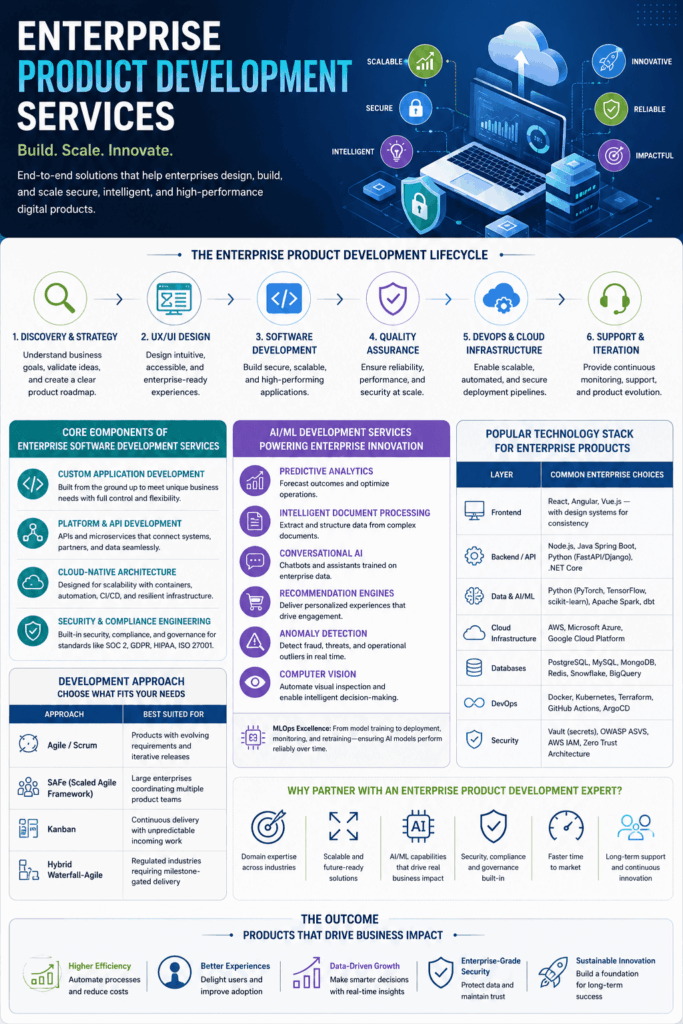
The Enterprise Product Development Lifecycle
Understanding how leading service providers structure the development lifecycle helps enterprise buyers set expectations, establish governance checkpoints, and avoid common delivery pitfalls.
Phase 1: Discovery and Product Strategy
A structured discovery phase is the foundation of every successful enterprise product engagement. This typically involves stakeholder interviews, competitive analysis, technical feasibility assessments, and the creation of a product requirements document (PRD) that aligns all parties before a line of code is written. Discovery is where assumptions are tested and costly misalignments are caught early.
Phase 2: Architecture and Technical Design
After strategy is locked, senior architects define the system design selecting the technology stack, mapping integration points with existing enterprise systems, and establishing the data model. This phase also includes decisions about cloud provider, deployment model (multi-tenant SaaS, on-premise, hybrid), and the security architecture.
Phase 3: Agile Development and Iteration
Development proceeds in two-week sprints, with each sprint delivering functional, tested software. Enterprise engagements typically involve multiple parallel workstreams frontend, backend, data/AI, and infrastructure that converge through carefully orchestrated integration events. Regular sprint reviews give business stakeholders visibility into progress and the opportunity to provide feedback before commitments harden.
Phase 4: Quality Assurance and Performance Testing
Enterprise-grade QA goes beyond functional testing. It includes load testing (simulating peak traffic conditions), security penetration testing, accessibility audits (WCAG 2.1 compliance), cross-browser and cross-device testing, and integration regression testing. QA is not a gate at the end of the process it runs continuously throughout development.
Phase 5: Deployment and Go-Live
Deployment for enterprise products is carefully orchestrated often involving phased rollouts, feature flags, rollback plans, and real-time monitoring dashboards. A well-executed go-live includes runbooks for every failure scenario and a dedicated war room protocol for the first 72 hours post-launch.
Phase 6: Continuous Improvement and Managed Evolution
The most successful enterprise products are never truly finished. Post-launch, the team operates in a continuous improvement cycle analyzing usage telemetry, prioritizing backlog items, managing technical debt, and planning quarterly roadmap increments. Many enterprise organizations maintain a long-term retained relationship with their product development services partner for exactly this reason.
Technology Stack Considerations for Enterprise Products
Technology choices made during the architecture phase have long-lasting consequences. Enterprise software development services providers should be technology-agnostic in their recommendations guiding stack selection based on the product’s specific requirements, not the vendor’s internal familiarity or staffing convenience.
| Layer | Common Enterprise Choices |
|---|---|
| Frontend | React, Angular, Vue.js – with design systems for consistency |
| Backend / API | Node.js, Java Spring Boot, Python (FastAPI/Django), .NET Core |
| Data & AI/ML | Python (PyTorch, TensorFlow, scikit-learn), Apache Spark, dbt |
| Cloud Infrastructure | AWS, Microsoft Azure, Google Cloud Platform |
| Databases | PostgreSQL, MySQL, MongoDB, Redis, Snowflake, BigQuery |
| DevOps | Docker, Kubernetes, Terraform, GitHub Actions, ArgoCD |
| Security | Vault (secrets), OWASP ASVS, AWS IAM, Zero Trust Architecture |
Common Challenges in Enterprise Product Development and How to Overcome Them
Challenge 1: Legacy System Integration
Most enterprises are not building greenfield products. They’re extending or replacing systems with 10, 20, or 30 years of accumulated business logic. The most effective approach is a strangler fig pattern wrapping legacy systems with modern APIs and progressively migrating functionality rather than attempting a high-risk big-bang rewrite.
Challenge 2: Stakeholder Misalignment
Enterprise products serve multiple internal constituencies: IT, legal, compliance, business units, and end users each with different priorities. Effective product development services providers establish a clear RACI (Responsible, Accountable, Consulted, Informed) model early in the engagement and use structured review ceremonies to surface and resolve conflicts before they block delivery.
Challenge 3: Scope Creep and Requirement Drift
In a complex enterprise environment, new requirements emerge constantly. A disciplined change management process where every scope addition is evaluated against timeline, budget, and architectural impact prevents the product from collapsing under its own weight. Experienced delivery managers treat scope conversations as strategic opportunities, not confrontations.
Challenge 4: Talent and Knowledge Transfer
Dependency on a single vendor creates long-term risk. Best-practice software development services engagements include explicit knowledge transfer protocols: well-documented codebases, architecture decision records (ADRs), onboarding guides, and joint development sessions that build internal capability alongside the product.
Challenge 5: AI Model Governance
As enterprises embed AI/ML capabilities into products, governance becomes a critical concern. Who audits model outputs for bias? How are training datasets documented and versioned? What happens when a model makes a high-stakes incorrect prediction? These questions must be answered in policy before the model goes to production.
Industry-Specific Applications of Enterprise Product Development Services
The principles of enterprise product development apply across industries, but the implementation priorities vary considerably by sector:
Financial Services and Fintech
Enterprise financial products operate in one of the most demanding regulatory environments in the world. Software development for this sector requires deep expertise in PCI-DSS compliance, real-time transaction processing, fraud detection algorithms, and open banking API standards. AI/ML capabilities are particularly impactful in credit risk modeling, algorithmic trading support, and customer churn prediction.
Healthcare and Life Sciences
Healthcare product development involves navigating HIPAA compliance, HL7/FHIR interoperability standards, and clinical workflow integration. AI applications in this sector include diagnostic imaging analysis, clinical decision support, and patient engagement tools that personalize care pathways at scale.
Manufacturing and Supply Chain
Industrial enterprises use product development services to build systems that connect shop floor IoT sensors with enterprise planning software, enabling predictive maintenance, real-time inventory optimization, and digital twin simulations. Machine learning models trained on operational data create early warning systems that reduce unplanned downtime by significant margins.
Retail and E-commerce
Retail enterprises are building increasingly sophisticated customer data platforms, personalization engines, and demand forecasting tools. AI/ML development services in this space focus on recommendation systems, dynamic pricing algorithms, and supply chain optimization models that respond to real-time signals across thousands of SKUs and locations.
Measuring Success: KPIs for Enterprise Product Development
Defining clear success metrics before development begins is one of the most important and most frequently skipped steps in enterprise product planning. Without agreed-upon KPIs, it’s impossible to objectively evaluate whether the product is delivering value or whether the development process is performing well.
The following metrics provide a balanced view of product health across delivery, performance, and business outcomes:
- Velocity and sprint predictability – Is the team delivering what they commit to, consistently?
- Defect escape rate – What percentage of bugs are found in production versus caught in QA?
- System uptime and reliability (SLA adherence) – Is the product meeting its availability commitments?
- Mean time to recovery (MTTR) – How quickly does the team restore service when incidents occur?
- Feature adoption rate – Are users actually using the features being built?
- Time to value (TTV) – How quickly do new users reach their first meaningful outcome?
- Net Promoter Score (NPS) – Do users recommend the product? Do internal stakeholders trust it?
- AI model accuracy and drift metrics – For ML-powered features, are models performing as expected over time?
Trends Shaping Enterprise Product Development in 2025 and Beyond
Composable Architecture and Headless Everything
Enterprises are moving away from monolithic platforms toward composable architectures where best-of-breed components are assembled via APIs. This gives product teams the flexibility to swap out individual capabilities without rebuilding from scratch, significantly reducing both cost and risk during technology transitions.
Platform Engineering as a Product Discipline
Internal developer platforms (IDPs) have emerged as a critical accelerator for enterprise engineering organizations. Rather than every product team solving infrastructure and tooling problems independently, platform engineering teams build self-service capabilities that let developers focus on product logic rather than operational complexity.
AI-Augmented Development
AI is transforming how software development services are delivered not just what they build. AI-assisted code generation, automated code review, intelligent test generation, and AI-powered documentation tools are reducing the time senior engineers spend on repetitive tasks, allowing them to focus on architecture, design, and the complex problem-solving that creates genuine product differentiation.
Edge Computing and Real-Time Processing
Enterprise products increasingly need to process data at the edge closer to where it’s generated rather than routing everything to a centralized cloud. This is particularly relevant for manufacturing, healthcare, and logistics use cases where latency, bandwidth, or data sovereignty constraints make centralized processing impractical.
Responsible AI and Explainability
As enterprise AI/ML applications make consequential decisions in credit, hiring, healthcare, and beyond regulators and users are demanding greater transparency. Explainable AI (XAI) frameworks that can articulate why a model reached a particular conclusion are becoming a non-negotiable component of responsible AI/ML development services.
Building an Internal-External Collaboration Model That Works
The most successful enterprise product programs don’t treat their development services partner as a vendor at arm’s length — they build a genuine collaboration model that blends internal and external expertise into a unified, accountable team.
Effective collaboration requires clarity on three dimensions:
- Ownership – Internal product managers own the roadmap and prioritization. External engineers own delivery. Neither should cross into the other’s domain without explicit alignment.
- Communication cadence – Weekly standups, bi-weekly sprint reviews, and monthly strategic reviews create a rhythm of accountability without micromanagement.
- Shared tooling – Using the same project management, communication, and code collaboration tools (Jira, Confluence, GitHub, Slack) eliminates information silos and creates a single source of truth for all stakeholders.
- Cultural integration – The best external teams feel like an extension of your organization. This means investing time in onboarding, including them in relevant all-hands meetings, and treating their engineers as colleagues rather than contractors.
Conclusion: Making the Right Investment in Enterprise Product Development
Enterprise product development services represent one of the highest-leverage investments an organization can make in its digital future. When executed well, they compress time-to-market, reduce technical debt, and create scalable product foundations that generate compounding returns as the business grows.
The organizations that win in digital product development are those that treat it as a strategic capability not a cost center. They invest in the right product development services partners, embed AI/ML development services where intelligence creates genuine competitive advantage, and maintain rigorous engineering standards that ensure their products remain resilient and extensible for years to come.
Whether you are building a new enterprise product from scratch, modernizing a legacy system, or embedding AI capabilities into an existing platform, the principles in this guide provide a foundation for making informed, confident decisions about your product development strategy.
Ready to Get Started?
The best time to engage a specialized enterprise product development services partner is before your internal team is at capacity not after. Early involvement means better architecture decisions, fewer change requests, and a much smoother path to launch. Evaluate partners now, define your product strategy, and build the foundation for products that scale.