
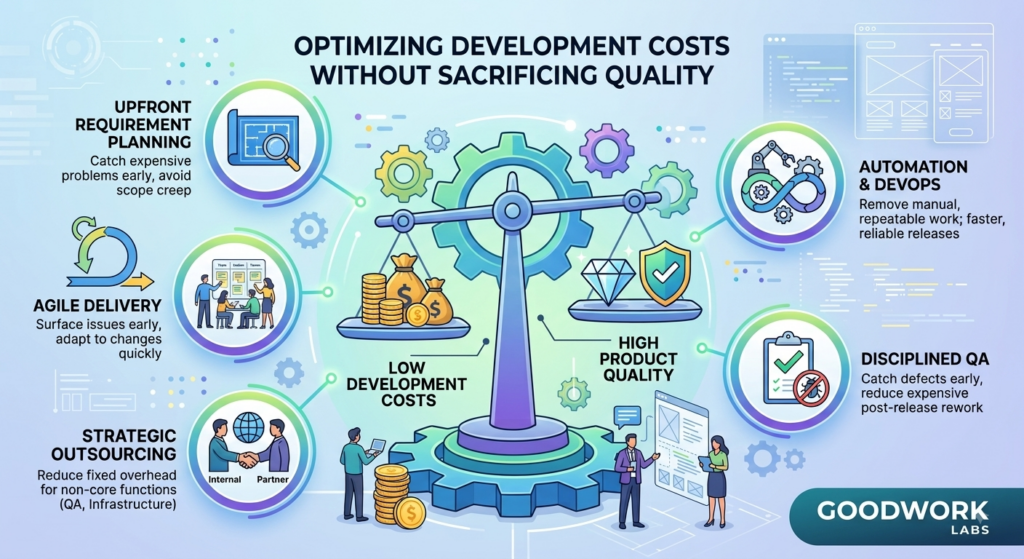
Tech companies can optimize development costs without sacrificing quality by combining upfront requirement planning, Agile delivery, selective outsourcing, automation, and disciplined QA. No single lever does the job alone cost overruns usually come from a mix of unclear requirements, late-stage rework, and manual, error-prone processes. Fixing all three areas together, rather than cutting corners on any one of them, is what lets a company hold the line on both budget and quality. The sections below walk through each lever in practical detail, along with the metrics that tell you whether it’s actually working.
Why Does Requirement Planning Matter for Cost Control?
Careful planning and requirement analysis catch expensive problems before a single line of code is written. Involving all stakeholders from day one product, engineering, design, and business establishes precise goals and expectations up front, so nobody is discovering misalignment halfway through a sprint. Producing user stories, wireframes, and clickable prototypes early cuts down on ambiguity and speeds up development, because engineers are building against a validated spec instead of a moving target. Companies that invest here avoid the costly mid-project pivots that come from discovering, three sprints in, that a feature was misunderstood or a workflow was mapped incorrectly.
Clear objectives also keep development teams focused on what matters, which lowers the risk of scope creep one of the single biggest silent cost-drivers in software projects. Scope creep rarely arrives as one big decision; it accumulates through dozens of small “while we’re at it” additions that each seem reasonable in isolation but collectively blow past the original budget and timeline. A well-documented requirements phase gives teams a clear reference point to push back against that drift, and gives leadership a concrete baseline to measure change requests against before approving them.
How Does Agile Reduce Development Costs?
Agile reduces costs by surfacing problems early, when they’re cheap to fix, instead of late, when they’re expensive. Breaking a project into smaller, testable increments lets teams catch and correct issues before they compound into larger, harder-to-untangle bugs. Agile also builds in regular collaboration between developers and stakeholders, so misalignment gets caught in a sprint review rather than at final delivery. This transparency improves decision-making and reduces rework, since teams are validating direction every couple of weeks instead of building for months against untested assumptions.
Because Agile plans adapt as requirements evolve, teams can respond to shifting priorities without throwing away completed work a rigid waterfall plan, by contrast, often forces a choice between expensive rework or shipping something the market no longer needs. Regularly shipping working increments also gives leadership real visibility into progress, rather than a “trust us” status update between milestones. That visibility matters for cost control specifically: it’s much cheaper to redirect a project after two weeks of wasted effort than after two months.
When Does Outsourcing Non-Core Work Save Money?
Outsourcing pays off when it’s applied to functions that support the product but aren’t the product itself infrastructure management, QA execution, or customer support, for example. Handling these in-house means carrying the full cost of hiring, training, and retaining specialists for work that doesn’t differentiate the company from its competitors. Outsourcing partners bring established processes and dedicated expertise without the fixed overhead of a full-time team, which is particularly useful for functions with variable or seasonal workload.
That frees the internal team to concentrate on the core product and features that actually create competitive advantage, which tends to shorten time to market as a side effect. The trade-off worth planning for is coordination overhead: outsourcing works best when the scope is well-defined and the handoff points between internal and external teams are clearly documented, otherwise the coordination cost can quietly eat into the savings.
How Do Automation and DevOps Lower Costs?
Automation and DevOps lower costs by removing manual, repeatable work from the release cycle. Automating testing, deployment, and code integration reduces both the time spent on these tasks and the human error that creeps into manual processes, especially in the moments right before a deadline when mistakes are most likely and most expensive. DevOps adds a culture layer on top of that automation closer collaboration between development and operations, and a continuous integration/deployment (CI/CD) pipeline that supports fast, frequent releases instead of high-stakes, infrequent ones.
The combined effect is a development cycle where code is tested thoroughly and shipped quickly, with fewer deployment-related fire drills eating into planned work. That translates directly into cost savings, since engineering time goes toward building rather than firefighting. Teams that invest early in a solid CI/CD pipeline also tend to see the payoff compound: each new automated check or deployment script keeps paying dividends on every future release, not just the one it was built for.
Why Should QA Be a Cost-Control Priority, Not an Afterthought?
Quality assurance is a cost-control measure, not just a quality measure the two are linked. Catching defects early through unit, integration, system, and user acceptance testing is dramatically cheaper than fixing them after release, when a bug might mean emergency patches, support tickets, or churned customers. The cost of a defect tends to multiply at each stage it survives, from a quick fix in development to a full incident response after launch.
A consistent QA track record also compounds over time: it builds customer trust, reduces the volume of support requests tied to product issues, and cuts down on the frequency of “hotfix” releases that eat into planned development time. In short, underinvesting in QA doesn’t save money it just moves the cost downstream and adds interest, usually in the form of engineering hours pulled off the roadmap to fight fires that better testing would have prevented.
What Metrics Should Companies Track to Manage Development Costs?
Tracking metrics turns cost optimization from guesswork into a data-driven process. Key indicators worth watching include development cycle time, defect rates, resource utilization, and customer satisfaction scores. Monitoring how long each development stage takes reveals where a process is dragging and where it can be tightened a stage that consistently runs long is usually a sign of unclear requirements or an undertested handoff, not just a slow team.
Analyzing defect rates and customer feedback highlights recurring problem areas, letting teams direct QA effort where it will prevent the most expensive post-release issues rather than spreading testing effort evenly across low- and high-risk areas alike. Metrics also make it possible to evaluate whether a given process change actually helped without that feedback loop, teams are optimizing on instinct rather than evidence, which tends to produce the same costly mistakes on repeat.
How Do These Strategies Work Together?
None of these levers operate in isolation, and treating them as a checklist to work through one at a time misses the bigger point. Strong requirement planning makes Agile sprints more predictable. Agile delivery makes automated testing more valuable, since there’s more frequent code to test. Automation frees up the QA time that outsourcing partners and in-house teams both need to focus where it counts. And metrics tie the whole loop together, showing which of these investments is actually moving the needle on cost and which isn’t. Companies that treat cost optimization as a system, rather than a single fix, tend to see savings that hold up over multiple project cycles instead of a one-time dip in spend.
The Bottom Line
Cutting development costs and protecting quality aren’t competing goals they’re solved by the same set of habits. Companies that plan requirements carefully, ship in Agile increments, outsource the right work to the right partners, automate what shouldn’t be manual, and treat QA and metrics as ongoing discipline rather than a final checkpoint consistently spend less while shipping more reliable software. The alternative cutting corners on any one of these to hit a short-term budget number almost always costs more later, in rework, support load, or lost trust. The companies that get this right aren’t the ones spending the least up front; they’re the ones spending deliberately, on the things that prevent expensive surprises down the line.
Ready to Build Without Blowing the Budget?
GoodWorkLabs helps tech companies plan, build and ship software that keeps both cost and quality under control.