Choosing between Agile and Waterfall software development is one of the highest-leverage decisions a technology leader makes before a single line of code is written. Agile vs Waterfall software development is not a debate with a single winner in 2026 it’s a fit-to-context decision shaped by requirement stability, regulatory pressure, team maturity, and how fast your market is moving. This guide breaks down both methodologies, the hybrid models enterprises now rely on, and a practical framework for choosing the right one for your next build.
What Is the Difference Between Agile and Waterfall Software Development?
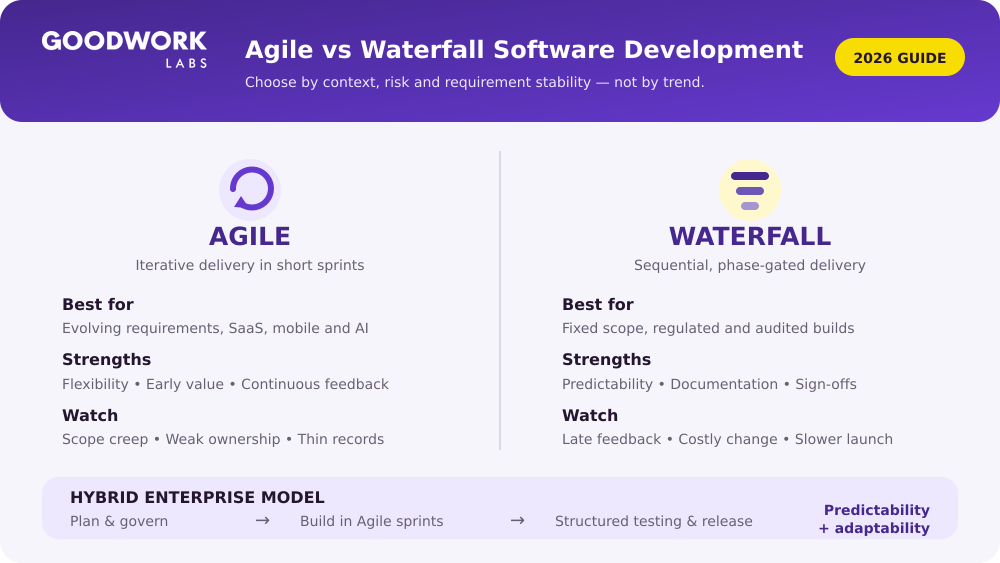
The core difference in Agile vs Waterfall software development is sequencing versus iteration. Waterfall completes requirements, design, build, test, and deployment as strict, sequential phases, while Agile delivers working software in short sprints that are reviewed and adjusted continuously. Waterfall suits projects with fixed, well-documented requirements and heavy regulatory oversight, such as banking or healthcare systems. Agile suits products where requirements evolve, such as consumer apps, SaaS platforms, or AI-driven features. Most enterprise software development service providers no longer treat this as an either/or choice; instead, they map each workstream to whichever model reduces risk and speeds delivery, then govern both tracks under one reporting structure.
What Is the Waterfall Methodology and When Should You Use It?
Waterfall is a linear software development methodology where each phase requirements, design, implementation, testing, deployment, and maintenance must be completed before the next begins. It remains the right choice in 2026 for projects with stable, well-documented requirements, fixed-price contracts, or strict regulatory sign-off, such as government platforms or core banking modules. Waterfall’s structure gives stakeholders a predictable delivery date and a paper trail of specifications, test plans, and requirement documents that regulated industries need for audits. Because scope is locked early, cost estimation and staffing plans are more reliable than in iterative models. The tradeoff is flexibility: once a phase closes, revisiting it typically means reopening earlier stages, which adds cost and delay.
Key Strengths of the Waterfall Model
Waterfall’s biggest strengths are clarity, documentation, and predictability. Every phase produces a defined deliverable, so stakeholders always know what’s complete and what comes next. The heavy documentation trail becomes a durable asset for compliance audits and future maintenance long after the original team has moved on. Because scope, cost, and timeline are fixed upfront, Waterfall also produces highly predictable budgets something finance and procurement teams in regulated sectors still prefer for fixed-price contracts.
Key Limitations of Waterfall in 2026
Waterfall’s core limitation is its resistance to change once a phase is signed off. Stakeholder feedback typically arrives only after development is complete, which is risky for products competing in fast-moving categories like AI tools, where user expectations shift every quarter. Long delivery cycles also delay time-to-market, letting more adaptive competitors capture the opportunity first. For products where requirements are genuinely uncertain, forcing a Waterfall structure onto the work simply pushes risk to the end of the project instead of removing it.
What Is Agile Software Development and Why Do Most Teams Use It?
Agile software development delivers working software in short, iterative sprints, with continuous stakeholder feedback shaping each cycle. It has become the default for web and mobile products, SaaS platforms, and AI-driven applications because requirements in these categories change faster than a Waterfall plan can absorb. Agile teams demo working increments every one to two weeks, so priorities can shift based on real user data rather than assumptions made months earlier. This is why Agile vs Waterfall software development comparisons increasingly favor Agile for anything customer-facing or subject to rapid technological change, including generative AI features refined through live usage rather than fixed upfront specifications.
Core Benefits of Agile Methodology
Agile’s biggest advantages are flexibility, early value delivery, and continuous improvement. Because scope is revisited every sprint, teams can reprioritize the moment market conditions or user feedback change, without waiting for a formal change-control process. Early and frequent releases let stakeholders validate assumptions with real usage data within weeks instead of months, shortening the path to ROI and surfacing defects while they’re still cheap to fix. Regular retrospectives build process improvement into the team’s rhythm, and the tight feedback loop between developers and end users typically produces a product that fits actual usage patterns.
Common Agile Challenges to Manage
Agile’s main risks are scope creep and thinner documentation. Because change is welcomed, backlogs can expand well beyond original estimates if product owners don’t enforce disciplined prioritization. Distributed teams across time zones can also struggle to sustain the daily collaboration Agile assumes, slowing decision-making on large or dispersed programs. Documentation is typically lighter than Waterfall by design, which can create gaps for regulated industries unless teams deliberately supplement sprints with compliance-grade records and audit trails alongside the working software.
Is Hybrid Development the Future of Agile vs Waterfall Software Development?
Yes hybrid delivery, often called Water-Scrum-Fall, is now the dominant approach for large enterprise programs. It applies Waterfall-style planning and governance at the program level while running Agile sprints at the team level, giving executives predictable milestones without sacrificing iteration speed. A typical pattern locks high-level requirements and budget in a 4-6 week planning phase, builds features in two-week Agile sprints, then closes with a structured, Waterfall-style testing and deployment phase. Enterprises managing legacy modernization alongside new digital products increasingly run both tracks in parallel, applying the right framework to each workstream instead of forcing one methodology across work with very different risk profiles.
Explore Our Custom Software Development Services →
How Do You Choose Between Agile and Waterfall for Your Project?
Choose based on requirement stability, regulatory exposure, and how much of the roadmap can change after launch. Pick Waterfall when requirements are genuinely fixed, contracts are fixed-price, or compliance sign-off is mandatory before release. Pick Agile when requirements will evolve, stakeholders want early and frequent releases, or the product competes in a fast-moving category such as AI or consumer mobile. Consider a hybrid model when you need executive-level predictability alongside team-level adaptability which describes most enterprise software application development services engagements today. Team experience matters too: Agile depends on disciplined product ownership, while Waterfall depends on genuinely complete upfront requirements, and neither works well half-implemented.
How Does AI Impact Agile and Waterfall Project Management in 2026?
AI is changing execution inside both methodologies without changing their core structure. In Agile teams, AI-assisted sprint forecasting and backlog analysis are replacing intuition-based planning with predictive estimates drawn from historical velocity data. In Waterfall programs, AI tools now simulate schedule risk across project dependencies before delays cascade into missed milestones, strengthening the predictability that makes Waterfall attractive for regulated builds. For AI-native products specifically, Agile remains the stronger fit in 2026, because model behavior and prompt quality are discovered through live usage rather than specified in advance, and evolving AI regulation increasingly expects continuous post-release monitoring that iterative delivery is built to support.
Why Partner with an Experienced Software Development Service for Agile or Waterfall Delivery?
Choosing a methodology is only half the decision execution quality determines whether it delivers results. GoodWork Labs is a global software development service with 17+ years of experience delivering both Agile and Waterfall programs for startups and Fortune 500 enterprises across the USA, Europe, UAE, and India. Our teams combine agile methodologies with structured governance where compliance demands it, building custom software solutions across Java Microservices, Node.js, Python, React, and cloud-native architectures. Whether your project needs disciplined Waterfall documentation for a regulated rollout or fast Agile iteration for a customer-facing product, our software application development services are built to match the methodology to the risk profile of the work not the other way around.
Schedule a Free Consultation with Our Experts →