Enterprise technology budgets are under intense scrutiny in 2026. CXOs and digital transformation leaders are expected to drive innovation, modernize legacy systems, adopt AI, and improve customer experience while reducing operational expenditure.
This is where a strategic software development company becomes a cost-optimization engine rather than a delivery vendor.
For enterprise decision-makers CTOs, COOs, CHROs, founders, and Heads of L&D—the right partner can unlock up to 40% cost savings through architecture modernization, automation, DevOps acceleration, and optimized custom software development services.
This article breaks down:
-
What defines the best enterprise software partner in 2026
-
The evolving market landscape
-
7 proven cost-reduction strategies
-
Real enterprise use cases
-
A decision framework for selecting the right solution
-
The future outlook for enterprise software development
What Defines the Best Software Development Company in 2026?
Enterprise buyers today evaluate partners differently than they did five years ago. Price alone is not the deciding factor. The best software development company is defined by measurable business outcomes.
1. Outcome-Based Engagement Models
Buyer Criteria: Can the partner tie development to KPIs?
Business Outcome: Predictable ROI, measurable cost savings
Modern enterprises demand accountability cost per release, cost per transaction, automation rates, and infrastructure savings.
2. Architecture Modernization Expertise
Buyer Criteria: Can they migrate from legacy systems to scalable cloud-native platforms?
Business Outcome: Reduced maintenance costs and improved scalability
Outdated systems often consume 60–80% of IT budgets. A partner delivering enterprise software development that eliminates technical debt directly reduces cost burdens.
3. Automation-First Approach
Buyer Criteria: Do they integrate AI, automation, and DevOps by default?
Business Outcome: Increased productivity and reduced manual overhead
Automation embedded within custom software development services significantly lowers operational expenditure.
4. Cloud Cost Governance
Buyer Criteria: Can they optimize cloud infrastructure spend?
Business Outcome: 25–40% infrastructure cost reduction
A mature software development service provider designs cost-efficient cloud architectures, preventing overprovisioning and idle resource waste.
5. Scalability and Flexibility
Buyer Criteria: Can teams scale up or down quickly?
Business Outcome: Lower hiring overhead, faster project velocity
Staff augmentation and modular development reduce fixed costs.
Market Landscape Overview: Enterprise Software in 2026
Before selecting a software development company, enterprise leaders must understand the solution landscape.
1. Traditional IT Vendors
-
Large system integrators
-
Long implementation cycles
-
High overhead costs
2. Niche Development Agencies
-
Specialized capabilities
-
Limited scalability
3. Offshore Development Firms
-
Cost advantages
-
Variable quality and governance
4. Product Engineering & AI-Driven Companies
-
Focus on automation and digital transformation
-
Architecture-first, ROI-focused models
Enterprises today prefer partners offering end-to-end custom software development services, AI integration, DevOps, and cloud optimization under a unified framework.
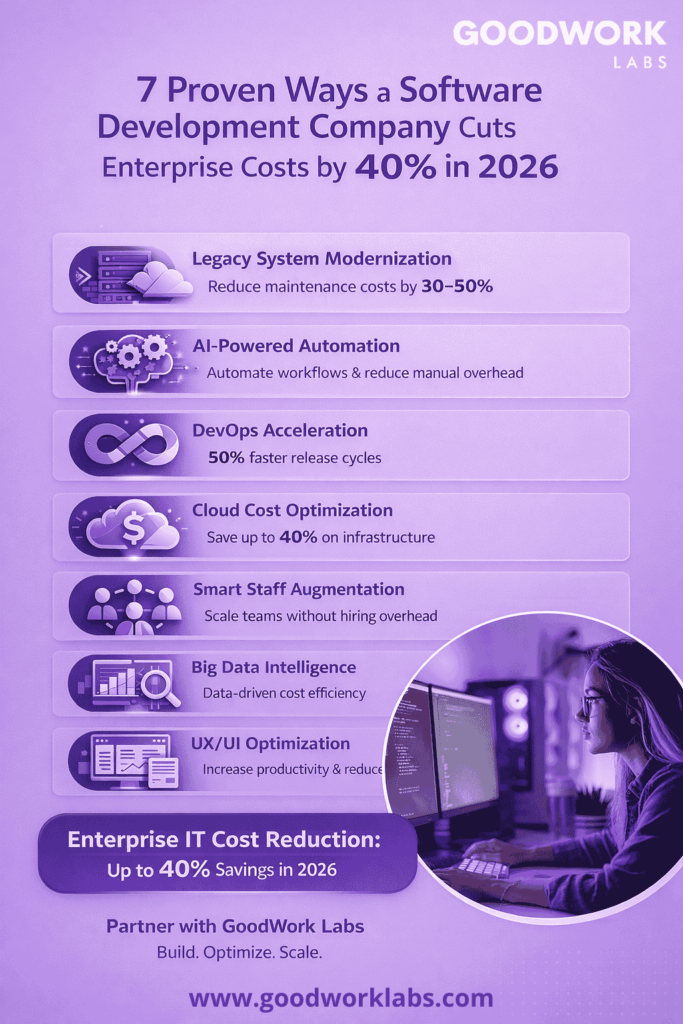
7 Proven Ways a Software Development Company Cuts Enterprise Costs
1. Eliminating Legacy System Maintenance
Legacy systems drain budgets through constant patching and downtime. A modern software development service replaces monolithic systems with microservices architecture.
Cost Impact:
-
30–50% reduction in maintenance
-
Lower system failure risk
-
Improved operational uptime
2. Automating Business Workflows with AI
AI-driven automation removes repetitive manual processes across HR, finance, operations, and L&D.
Examples:
-
AI chatbots for support
-
Predictive analytics for demand forecasting
-
Automated compliance monitoring
Cost Impact:
-
Reduced staffing overhead
-
Faster decision cycles
-
Lower error rates
3. DevOps Acceleration
DevOps practices reduce deployment delays and infrastructure inefficiencies.
Impact of DevOps Services:
-
50% faster release cycles
-
Reduced downtime
-
Automated testing pipelines
For enterprises, delayed releases translate directly into lost revenue. DevOps reduces that risk.
4. Cloud Optimization & FinOps Integration
Cloud bills can spiral without governance. A strategic software development company integrates FinOps practices.
Savings Levers:
-
Auto-scaling
-
Serverless architecture
-
Containerization
-
Reserved instance optimization
Result: Infrastructure savings up to 40%.
5. Smart Staff Augmentation
Instead of long-term hiring, enterprises leverage flexible development teams.
Cost Benefits:
-
No recruitment overhead
-
No idle payroll costs
-
Faster time to productivity
6. Data-Driven Decision Enablement
Big data platforms reduce waste and improve forecasting accuracy.
Impact:
-
Lower inventory costs
-
Better marketing ROI
-
Improved supply chain efficiency
7. UX Optimization for Productivity
Poor UX leads to inefficiencies. A refined enterprise interface reduces support tickets and training costs.
Business Outcome:
-
Improved employee productivity
-
Increased user adoption
-
Lower churn rates
Strategic Brand Positioning: GoodWork Labs as a Cost-Optimization System
Unlike traditional vendors, GoodWork Labs operates as a technology transformation operating model, not just a service provider.
As a leading software development company, GoodWork Labs integrates:
-
Enterprise software development
-
AI-first architecture
-
DevOps acceleration
-
Cloud governance frameworks
-
Custom software development services
-
Staff augmentation at scale
The approach is system-driven:
Assess → Modernize → Automate → Optimize → Scale
This operating model ensures measurable cost efficiency rather than isolated project delivery.
Business Impact & ROI
Partnering with a mature software development service provider like GoodWork Labs delivers:
1. Speed
-
30–50% faster deployment cycles
-
Accelerated digital transformation timelines
2. Productivity
-
Automated workflows
-
Reduced manual intervention
-
Improved cross-functional collaboration
3. Cost Efficiency
-
Up to 40% IT cost reduction
-
Lower infrastructure waste
-
Optimized development spend
4. Risk Reduction
-
Reduced downtime
-
Stronger cybersecurity compliance
-
Improved governance
5. Scalability
-
Modular cloud-native architecture
-
Flexible team structures
-
Rapid market expansion capability
Enterprise Use Cases
1. L&D Digital Modernization
A global enterprise integrates AI-powered learning management systems to reduce training costs and improve workforce productivity.
2. Fintech Cloud Migration
Migration to containerized infrastructure reduces infrastructure spend by 35% while improving security compliance.
3. Retail Demand Forecasting
AI-based predictive analytics reduces inventory waste by 20%.
4. Healthcare Process Automation
Automated patient workflow systems reduce administrative overhead and improve compliance tracking.
How to Choose the Right Software Development Company
Enterprise leaders should evaluate partners based on:
1. Company Size
-
Large enterprises need scalable teams and governance frameworks.
-
Mid-market companies require flexible engagement models.
2. Industry
-
Regulated industries require compliance expertise.
-
Retail and fintech demand scalability and performance.
3. Digital Maturity
-
Early-stage digital adoption requires foundational architecture.
-
Advanced enterprises need AI optimization and DevOps acceleration.
4. Technology Stack Alignment
Ensure compatibility with cloud providers, data ecosystems, and security standards.
Future Outlook: Beyond 2026
Enterprise software development is shifting toward:
-
AI-native platforms
-
Autonomous DevOps
-
Zero-trust cloud security
-
Predictive cost optimization
-
Platform-based digital ecosystems
Early adopters of automation-first custom software development services will gain long-term competitive advantage.
Delaying modernization increases technical debt and future cost burdens.
Conclusion: The Strategic Path to 40% Cost Reduction
A high-performing software development company is no longer just a vendor—it is a transformation partner.
By modernizing architecture, embedding AI, accelerating DevOps, optimizing cloud infrastructure, and delivering scalable custom software development services, enterprises can achieve sustainable cost reduction without slowing innovation.
Ready to Cut Enterprise IT Costs by 40%?
Partner with GoodWork Labs to transform your technology into a high-performance, cost-optimized growth engine.
Schedule a strategic consultation today and build your enterprise advantage for 2026 and beyond.