
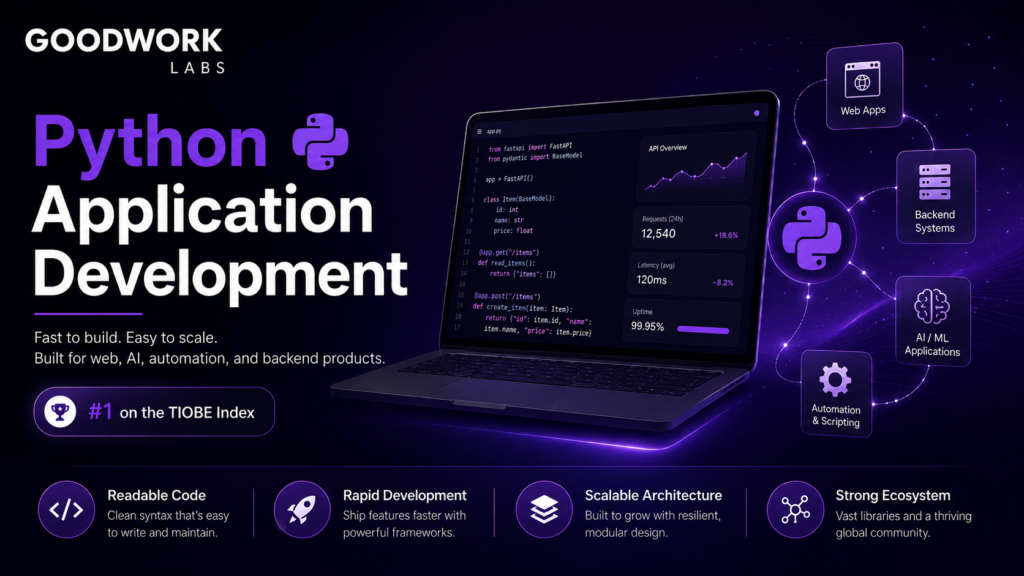
Python is the right choice for application development because it combines a simple, readable syntax with a mature ecosystem that speeds up development without sacrificing scalability. As of April 2026, Python holds the #1 spot on the TIOBE Index at roughly 21% the highest rating of any language in the index’s history driven largely by AI and machine learning adoption. But its value for application development goes well beyond AI hype. Python application development consistently reduces build time, lowers long-term maintenance cost, and gives teams a language that’s genuinely easier to debug and extend as an app grows. Its object-oriented design, extensive standard library, and active community mean developers spend less time reinventing common functionality and more time solving business-specific problems.
This is especially valuable for companies balancing tight timelines with long-term product stability, since Python’s readability lowers the learning curve for new developers joining a project mid-build. For businesses deciding what to build their next product in, that combination of speed, readability, and ecosystem depth is hard to match and it’s a big part of why Python has moved from a “good option” to the default starting point for so many new application builds.
What Makes Python Application Development Different From Other Languages?
Python application development stands apart from other approaches because it’s built on an interpreted, object-oriented language designed around readability first code that looks close to plain English is easier to write, review, and maintain than most alternatives. Unlike languages that demand heavy boilerplate or rigid type declarations, Python uses “duck typing”: if an object behaves the way your code expects, you can use it without pre-declaring its exact type. This flexibility speeds up prototyping significantly, which is why Python is the language most beginners are advised to learn first and the language many teams reach for when they need to move from idea to working software quickly. It’s also why software development companies rely on Python to compress timelines on projects where speed to market matters as much as code quality.
What Are the Key Benefits of Python for Software Development?
The core benefits Python application development brings to software teams are faster build cycles, easier maintenance, and a standard library that removes the need to build common functionality from scratch. Python ships with built-in support for XML parsing, CSV and ZIP file handling, and libraries for nearly every internet protocol and data format a typical application needs, which cuts down on third-party dependencies. Its clean syntax makes debugging faster, since errors are easier to trace through readable code than through dense, symbol-heavy languages. Python also supports modules and packages natively, so teams can structure large applications cleanly instead of letting a codebase turn into an unmanageable single file. Combined, these factors are why Python application development tends to cost less to maintain over an app’s lifecycle, not just to build initially.
Is Python Good for Web Application Development?
Yes Python application development is one of the strongest choices for building web applications, backed by mature frameworks like Django and Flask and a large, active community. Django gives teams a full-featured framework with built-in security, authentication, and admin tooling out of the box, which is ideal for data-heavy or enterprise-grade applications. Flask offers a lighter, more flexible alternative for teams that want more control over architecture decisions. Alongside Ruby and JavaScript, Python web development is one of the most widely adopted approaches in the industry, and its ecosystem of libraries makes it well-suited for everything from content-driven sites to complex, API-backed platforms. This maturity means teams aren’t just picking a language they’re picking a proven, well-supported path to production.
How Does Python Compare for AI, Automation, and Backend Development?
Python is the dominant language for AI, machine learning, and automation work because its libraries including NumPy, Pandas, and TensorFlow turn complex tasks into a few lines of readable code. This is a major reason Python’s popularity has surged industry-wide over the past two years: as more companies build AI features into their products, Python becomes the natural backend choice, since AI/ML work and core application logic can live in the same language and codebase. For backend development specifically, Python’s frameworks handle API design, database interaction, and business logic cleanly, without forcing teams to context-switch between languages for different parts of the stack. For a business planning an application with AI features on the roadmap even if not on day one building the core in Python avoids a costly re-architecture later.
Why Do Businesses Choose to Outsource Python Programming?
Businesses outsource Python programming to access specialized, senior-level talent without the time and cost of building an in-house team from scratch. Custom Python development requires developers who understand not just the language but also which framework, architecture, and libraries fit a specific business problem expertise that takes years to build internally. Working with an established Python development company gives businesses immediate access to that judgment, along with existing quality-assurance processes and project management structure. This has become standard practice across industries, not because in-house teams can’t do the work, but because outsourcing to the right partner is usually faster and lower-risk than hiring, training, and scaling a specialized team for a single project.
How Do You Choose the Right Python Development Company?
Choosing the right partner for Python application development comes down to three things: a verifiable portfolio of comparable projects, transparent communication practices, and a team structure that matches your project’s complexity. Ask to see applications the company has actually shipped, not just case study summaries, and look for evidence of ongoing maintenance work, not just one-off builds long-term support is where a lot of Python application development partnerships succeed or fail. A good partner will also ask detailed questions about your specific requirements before proposing a solution, rather than offering a generic package. GoodWorkLabs, a Bangalore-based software and product development company, works with businesses across these stages, from early architecture decisions through to hire Python developers arrangements for ongoing scaling needs.
Talk to Our Python Development Team →
Making the Right Call on Python Application Development
Python application development isn’t the right fit for every single use case, but for the majority of web apps, backend systems, automation tools, and AI-integrated products, it offers a rare combination: fast development, lower long-term maintenance cost, and a growing ecosystem that keeps expanding what’s possible with the language. Its current position as the top-ranked language on the TIOBE Index isn’t a fluke it reflects genuine, sustained demand from businesses building the kind of applications most companies actually need. The decision that matters most isn’t whether to use Python; for most projects, that case is already strong. It’s finding a development partner with the experience to execute it well.
Check out GoodWork Labs’ portfolio and see how their team approaches custom Python development for businesses at different stages of growth.
Get in Touch With GoodWorkLabs | Start Your Python Project With GoodWorkLabs →