
AI-powered dynamic pricing is a pricing method where machine learning models automatically adjust product prices in real time based on demand, competitor moves, inventory levels, and customer behavior. Instead of a fixed price list reviewed quarterly, retailers use algorithms that recalculate optimal prices continuously sometimes every few minutes.
Retailers using AI-powered dynamic pricing report gross margin improvements in the 2–10% range, according to multiple industry analyses from McKinsey and retail research firms. Large-scale retailers like Amazon are known to change prices millions of times a day. For mid-market and enterprise retailers alike, the shift from static to AI-driven pricing has moved from a competitive advantage to a baseline expectation, especially as e-commerce competition compresses decision windows to minutes rather than weeks.
This article breaks down how AI-powered dynamic pricing actually works, what data feeds it, how it differs from traditional pricing, and how retailers can start implementing it responsibly.
How Does AI-Powered Dynamic Pricing Work?
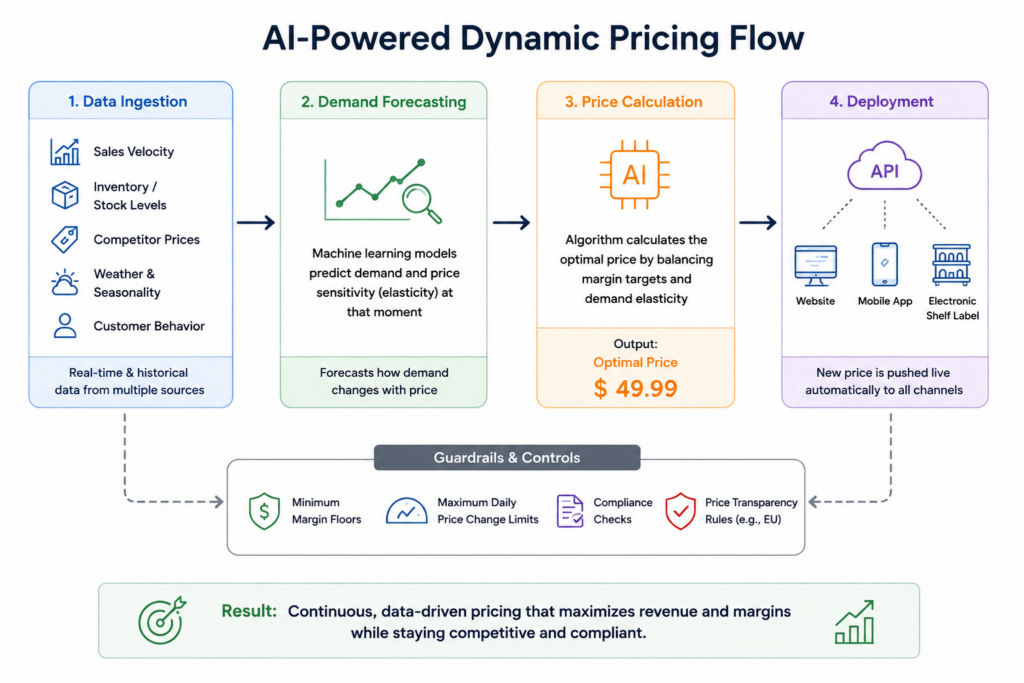
AI-powered dynamic pricing works by feeding real-time data demand signals, competitor prices, inventory, and customer behavior into machine learning pricing models that calculate an optimal price and update it automatically. The system replaces manual price reviews with continuous, data-driven recalculation.
The typical pipeline has four stages: data ingestion (sales velocity, stock levels, competitor scraping, weather, seasonality), demand forecasting (predicting how sensitive buyers are to a price change at that moment), price calculation (an algorithm balances margin targets against demand elasticity), and deployment (the new price pushes live via API to the website, app, or electronic shelf label). Enterprise AI development teams typically layer in guardrails minimum margin floors, maximum daily price-change limits, and compliance checks so pricing stays responsive without becoming erratic or violating consumer protection rules like the EU’s price-transparency requirements.
What Data Powers AI-Powered Dynamic Pricing Models?
AI-powered dynamic pricing models run on five core data streams: historical sales data, real-time inventory levels, competitor pricing feeds, customer behavior signals, and external demand drivers like seasonality or local events. The richer and cleaner this data, the more accurate the pricing output.
Historical sales data trains the model to recognize price elasticity how much demand shifts when price moves up or down for a specific SKU. Inventory data prevents the system from discounting stock that’s already scarce or overpricing items that are overstocked. Competitor pricing feeds, gathered through web scraping or third-party price-intelligence tools, keep the retailer positioned correctly in the market. Customer behavior signals browsing patterns, cart abandonment, loyalty tier enable personalized pricing within legal bounds. External factors like weather, local events, or holidays adjust demand forecasts for time-sensitive categories like apparel, groceries, and travel-adjacent retail. This is where data engineering and AI/ML solutions typically matter as much as the pricing algorithm itself a model is only as good as the pipeline feeding it.
How Is AI-Powered Dynamic Pricing Different From Traditional Pricing?
Traditional pricing relies on fixed rules set manually and reviewed periodically often weekly, monthly, or seasonally. AI-powered dynamic pricing continuously recalculates prices using live data, adjusting automatically as market conditions change, sometimes within minutes.
The practical difference shows up in three areas: speed, granularity, and personalization. Traditional rule-based pricing applies the same markdown percentage across a whole category regardless of how individual SKUs are actually performing. AI-powered dynamic pricing sets prices at the SKU-store level, factoring in local demand, local competition, and local inventory rather than a blanket rule. It also reacts within a single sales day instead of waiting for the next scheduled price review, which matters most during high-velocity periods like flash sales, festive sales events, or sudden competitor discounting.
| Factor | Traditional Pricing | AI-Powered Dynamic Pricing |
|---|---|---|
| Update frequency | Weekly/monthly | Real-time to hourly |
| Granularity | Category-level | SKU-store level |
| Data inputs | Cost + fixed margin | Demand, competition, inventory, behavior |
| Personalization | None | Segment or customer-level (where compliant) |
| Human effort | High (manual review) | Low (model-managed, human-supervised) |
What Are the Business Benefits of AI-Powered Dynamic Pricing for Retailers?
AI-powered dynamic pricing delivers measurable gains in margin, revenue, and competitive responsiveness. Industry research consistently places margin improvements in the 2–10% range and revenue uplift in the mid-single to low-double digits for retailers with mature implementations.
Beyond the headline numbers, the operational benefits matter just as much. Pricing teams shift from manually adjusting spreadsheets to supervising and tuning a system, freeing analyst time for strategy instead of repetitive price entry. Retailers also gain the ability to protect margin during demand spikes and clear inventory faster during slow periods, rather than discounting broadly and eroding margin unnecessarily. For retailers competing against larger players with mature pricing engines such as major marketplaces that reprice constantly AI-powered dynamic pricing closes a real competitiveness gap rather than being a “nice to have” analytics project.
Book a Consultation With Our AI/ML Development Experts →
What Are the Risks and Challenges of AI-Powered Dynamic Pricing?
The main risks of AI-powered dynamic pricing are customer trust erosion, regulatory exposure, and data quality failures. Prices that swing too frequently or too visibly can feel unfair to shoppers, and poorly governed personalization can cross into discriminatory pricing.
Regulatory exposure is a growing concern: frameworks like the EU’s price-transparency rules now require retailers to display reference prices alongside discounts, and AI pricing systems must be built to log and surface that history automatically. Data quality is the quieter risk a pricing model fed on incomplete competitor data or stale inventory counts will make confidently wrong decisions. This is why ML engineering services and MLOps services matter beyond the initial model build: retailers need monitoring in place to catch model drift, unusual price swings, or degraded forecast accuracy before it affects the customer experience or the bottom line.
How Can Retailers Get Started With AI-Powered Dynamic Pricing?
Retailers should start AI-powered dynamic pricing with a narrow, well-instrumented pilot one category or region before scaling. This limits risk, validates data quality, and lets teams calibrate guardrails before rolling the system out across the full catalog.
A practical rollout sequence looks like this: assess data readiness (do you have clean historical sales, inventory, and competitor data?), define guardrails (minimum margins, maximum price-change frequency, compliance rules), pilot on a bounded category, measure against a control group, and then expand. Partnering with a team experienced in enterprise AI development shortens this timeline considerably, since the data engineering, model architecture, and MLOps monitoring can be built on proven frameworks rather than from scratch. Retailers without in-house ML engineering capacity often find that an AI/ML advisory engagement covering readiness assessment, PoC development, and deployment is the fastest path from static pricing to a production-ready pricing engine.
Conclusion
AI-powered dynamic pricing has moved from a marketplace-only advantage to a baseline expectation for retailers who want to protect margin in a market that shifts by the hour. The retailers seeing real gains aren’t changing prices the most often they’re pairing clean data with well-governed guardrails and continuous monitoring.
The path forward doesn’t require a full-catalog overhaul. A focused pilot on one category, backed by the right AI/ML development service, is enough to prove the model and set the stage for wider rollout.
If you’re evaluating readiness, start with an honest assessment, not a rushed rollout. GoodWorkLabs‘ AI/ML advisory team can help you assess your data, define guardrails, and build a pricing engine that grows with your business.