
Enterprise IoT architecture is the blueprint that connects physical devices to cloud platforms and business apps through four layers: device, gateway, cloud, and application. Get it right and sensor data becomes decisions in seconds. Get it wrong and projects stall at the pilot stage. IoT Analytics counted 18.5 billion connected IoT devices in 2024 and expected the number to grow 14% to 21.1 billion by the end of 2025, so your design must handle serious scale.
What Is Enterprise IoT Architecture?
Enterprise IoT architecture is the structured design that defines how connected devices, networks, data platforms, and business applications exchange information securely and at scale. In simple terms, it answers one question: how does a reading from a sensor on a factory floor become an alert on a manager’s screen?
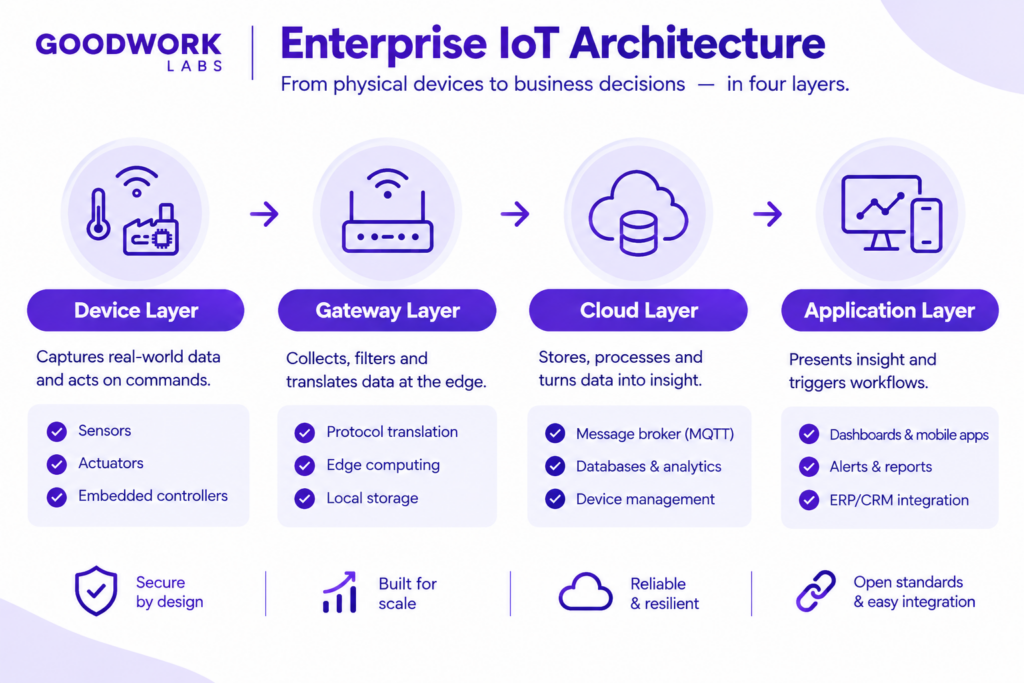
Unlike a consumer smart-home setup, an enterprise system must support thousands of devices, strict security rules, and links to existing software such as ERP and CRM. Most designs follow four layers:
A weakness in one layer affects all the others.
How Do the IoT Architecture Layers Work Together?
The IoT architecture layers form a pipeline. Data moves up from devices to applications, and commands travel back down. In enterprise IoT architecture, each layer should do one job well and hand over clean data to the next.
What Does the Device Layer Do?
The device layer captures real-world signals and, where needed, acts on them. It includes sensors for temperature, vibration, location, or energy use, and actuators such as valves and relays, all driven by small embedded processors. Many devices run on batteries, so designers choose low-power connectivity such as Bluetooth, LoRaWAN, or cellular IoT. IoT Analytics found that 24% of connected IoT devices rely on Bluetooth, which shows how varied these choices are.
Three decisions matter most here: how each device proves its identity, how it receives over-the-air firmware updates, and how long the hardware must last. Skipping any of them leads to costly site visits later. Treat every device as a long-lived asset that must stay patchable for years.
Why Do You Need a Gateway Layer?
A gateway sits between devices and the cloud to translate protocols, filter data, and keep operations running when the network drops. Many industrial sensors speak Modbus or OPC UA, while cloud platforms expect MQTT or HTTPS. The gateway bridges that gap.
It also runs edge computing logic, so only useful readings travel upstream. For example, a gateway can discard 99 normal temperature readings and send only the one that crosses a safe limit. This cuts bandwidth cost and response time. Gateways can also store data during outages and forward it when the link returns. For urgent tasks, such as stopping a faulty machine, acting at the edge in milliseconds is safer than waiting for a cloud round trip. Plan gateway security patching early, because these devices sit on your network edge.
What Happens in the Cloud Layer?
The cloud layer receives device data, stores it, and turns it into insight. Key IoT architecture components here include a message broker (often using MQTT, an OASIS standard), a device registry, a time-series database, a rules engine, and analytics or machine learning services. The cloud also handles device management, such as remote configuration and firmware rollout.
Data is usually split into hot storage for live dashboards and cold storage for long-term analysis and model training. Design this layer around three needs: elastic scale as device counts grow, low latency for alerts, and clear data retention rules for compliance. Open standards and well-documented APIs reduce vendor lock-in if you change platforms later.
What Is the IoT Application Layer, and What Should It Include?
The IoT application layer is where people and business systems use IoT data. It includes dashboards, mobile apps, alerting tools, reports, and integrations with ERP, CRM, and maintenance software. Users see only this layer, so its design decides whether the whole system gets adopted.
A strong application layer shows live status at a glance, lets operators drill into a single device, sends alerts to the right person, and enforces role-based access. It should also expose secure APIs so other systems can use the data. Common examples include predictive maintenance screens in factories, fleet tracking in logistics, and cold-chain monitoring in pharma. Good UX matters because an alert nobody understands is as useless as no alert. Build for the daily workflow of the operator, not only for the data team.
Which IoT Architecture Components Keep the System Secure and Reliable?
Security and operations components run across every layer instead of sitting in one place. Start with device identity: each device needs a unique credential, ideally held in secure hardware, and encrypted connections such as mutual TLS. Add encryption at rest, network segmentation, and least-privilege access for users and services.
Over-the-air updates let you patch vulnerabilities quickly. Monitoring and logging show device health and unusual behaviour. Standards give a useful baseline: NIST IR 8259 describes core cybersecurity activities for IoT device makers, and IEC 62443 covers industrial control system security. Reliability needs planning too, through retry logic, offline buffering, and redundant brokers and databases. Treat these as core IoT system architecture requirements from day one. Adding security to a fleet that is already deployed costs far more than designing it in.
How Do You Plan IoT System Architecture for Scale?
Plan IoT system architecture by working backwards from the business outcome, then sizing each layer for growth. Use this checklist:
- Define the use case and the decision it supports, such as cutting downtime by acting on vibration data.
- Estimate device count, message rate, and data volume for year one and year three.
- Choose connectivity for each site: Wi-Fi, cellular, LoRaWAN, or wired.
- Decide what runs at the edge and what runs in the cloud.
- Pick open protocols and APIs to avoid lock-in.
- Build security and update paths into the first pilot.
- Test integration with existing enterprise systems early.
Start with a small pilot on real devices, measure latency and cost per device, then scale in stages. Many enterprise IoT architecture projects stall because pilots ignore integration and security, so include both from the start.
How Do You Choose the Right Enterprise IoT Solutions Partner?
Choose a partner who can work across all four layers, not just one. Ask for proven delivery experience, a clear security approach, and references for similar integrations. Check that they design for open standards and hand over documentation your team can own.
GoodWorkLabs has delivered 500+ projects for 300+ clients, and our team builds enterprise IoT solutions that cover device connectivity, cloud platforms, and user-facing apps. A short architecture review before development helps surface risks early and keeps enterprise IoT architecture decisions aligned with business goals. For market context, read our post on why IoT application development is in demand.
Ready to turn your IoT idea into a working system?