
Enterprises should consider custom e-commerce development when their catalog complexity, ERP integrations, or checkout logic outgrow what Shopify Plus or Adobe Commerce (Magento) can support without heavy workarounds. For most small and mid-market businesses, a managed platform is still the faster, cheaper, lower-risk path to market. But once a business hits a certain scale multi-warehouse logistics, deep B2B pricing rules, or app-store dependency costs that keep climbing custom e-commerce development stops being a luxury and starts being the only architecture that actually fits. This guide breaks down exactly where that line sits, what it costs to cross it, and how to decide with evidence instead of guesswork.
What Is Custom E-Commerce Development and How Is It Different From Shopify or Magento?
Custom e-commerce development means building your storefront, checkout, and backend logic from the ground up (or on a highly modified open framework) instead of running your store inside a managed platform like Shopify or a semi-managed one like Adobe Commerce. The core difference is control: a custom build gives you full ownership of the database, infrastructure, and every business rule in your checkout flow, while Shopify and Magento hand you a pre-built system you configure and extend through apps or extensions. That control comes at a cost custom development means your team owns hosting, security patching, and every feature that a platform vendor would otherwise maintain for you. It’s the right trade to make when your business logic is too specific for off-the-shelf configuration to handle cleanly.
Shopify Plus vs Adobe Commerce: Which Enterprise Platform Should You Compare Against First?
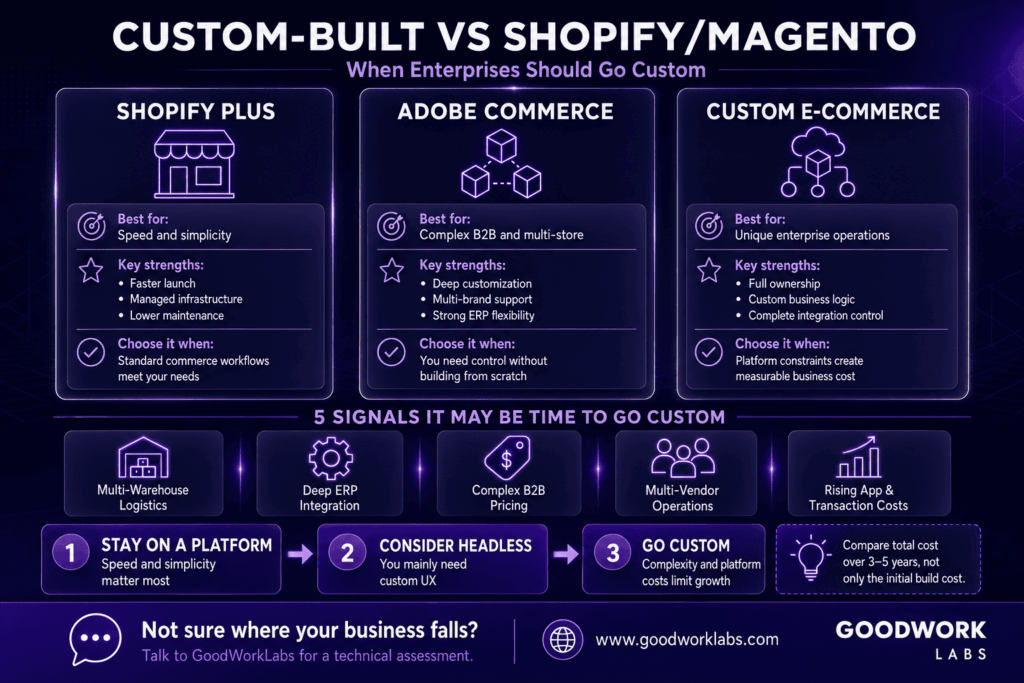
Shopify Plus and Adobe Commerce (the enterprise edition of Magento) are the two platforms enterprises should actually benchmark against before deciding to go custom not their entry-level counterparts. Shopify Plus is a fully managed, SaaS-based platform built for speed to market and operational simplicity, with a growing app ecosystem and improving AI/automation tooling. Adobe Commerce is open-source at its core, giving development teams direct access to code and deep customization for complex catalogs, multi-brand operations, and heavy ERP integration but it demands in-house or outsourced technical expertise to build, host, and maintain. For most enterprise retailers in 2026, Shopify Plus wins on total cost of ownership and time to market, while Adobe Commerce remains the stronger fit for businesses with deep B2B requirements, multi-language, multi-store operations, and the technical team to support it.
Talk to our team for a technical assessment before you commit budget either way.
When Should an Enterprise Choose Custom E-Commerce Development Over a Platform?
An enterprise should choose custom e-commerce development when platform constraints start creating real business cost, not just minor inconvenience. The clearest triggers are: complex multi-warehouse or omnichannel inventory logic that off-the-shelf apps can’t cleanly model, deep ERP or legacy system integration where platform APIs create ongoing friction, unique B2B pricing and quoting workflows that don’t fit standard checkout logic, and multi-vendor marketplace models with custom commission and payout structures. Rising transaction fees and app subscription costs at high order volumes are another signal at enterprise scale, those recurring costs can outweigh the upfront cost of a custom build over a three-to-five-year horizon. If your roadmap includes none of these, staying on a managed platform is almost always the more efficient choice.
What Does Custom E-Commerce Platform Development Actually Cost Compared to Shopify or Magento?
Custom e-commerce platform development typically costs more upfront than a Shopify Plus or Adobe Commerce subscription, but the real comparison has to include total cost of ownership over several years, not just the initial build. Shopify Plus costs are predictable subscription fees plus transaction fees that scale with revenue while Magento Open Source is free to license but requires hosting, development, and maintenance investment that can run into tens of thousands of dollars in year one alone. A custom build front-loads engineering cost but removes recurring transaction fees, app subscription creep, and vendor pricing changes outside your control. For high-GMV enterprises, the breakeven point often arrives faster than expected once transaction fee erosion and app costs are modeled honestly across a multi-year horizon.
Is Headless Commerce a Middle Ground Between Custom and Platform-Based E-Commerce?
Yes, headless commerce is a genuine middle ground, and it’s worth evaluating before committing to a fully custom build. A headless setup such as a custom frontend built on Shopify’s commerce backend separates the customer-facing experience from the backend commerce engine, giving you a fully custom brand experience without the burden of managing complete infrastructure. This approach suits enterprises that need design and UX flexibility but don’t have B2B, ERP, or catalog complexity severe enough to justify a fully custom backend. It’s faster to launch than a ground-up build and still leaves room to migrate to a fully custom architecture later if complexity grows. For many mid-to-large retailers, headless is the pragmatic middle step rather than an all-or-nothing decision.
What Are the Real Risks of Going Custom With Enterprise E-Commerce Development?
The biggest risk in custom e-commerce development is the responsibility shift: your team becomes accountable for performance, security, and uptime that a platform vendor would otherwise guarantee. Poorly architected custom stores can collapse under unexpected traffic spikes, while well-architected ones handle millions of sessions reliably the difference comes down to deliberate infrastructure and DevOps investment, not the decision to go custom itself. Ongoing maintenance, security patching, and feature development also become permanent line items on your engineering budget rather than a vendor’s responsibility. Platform risk isn’t eliminated either way Shopify and Magento carry their own risks around policy changes and vendor lock-in but with custom development, every risk becomes yours to manage directly rather than shared with a platform provider.
Explore staff augmentation to extend your in-house team instead of building a full engineering function from scratch.
How Should Enterprises Decide Between Custom, Shopify Plus, and Adobe Commerce?
The decision comes down to matching platform capability to your actual operational complexity, not brand reputation or what a competitor uses. Start by mapping your non-negotiables: if you need deep ERP integration, complex multi-vendor commission logic, or B2B pricing rules that don’t fit standard checkout flows, custom or Adobe Commerce are your realistic options. If speed to market, predictable costs, and a lower technical maintenance burden matter more than infrastructure ownership, Shopify Plus is very likely the better fit. A structured technical discovery phase mapping current systems, integration requirements, and 3-year growth plans removes the guesswork and prevents an expensive rebuild 18 months after launch. GoodWork Labs runs exactly this kind of discovery phase before recommending an architecture, so the platform decision is based on your operational reality, not a template.
Talk to our team about a technical assessment, or explore how staff augmentation can extend your in-house team if you’re leaning toward a custom build.
Conclusion
Custom e-commerce development is the right choice only when your business has moved beyond what standard platforms can support cleanly. If your operations depend on complex catalogs, ERP integrations, multi-warehouse logic, or B2B pricing and checkout rules that keep forcing workarounds, then the real question is no longer whether custom is worth it it is whether your current platform is slowing growth. For many businesses, Shopify Plus or Adobe Commerce will still be the smarter and faster option, but once scale, control, and long-term efficiency become the priority, custom architecture can be the most practical path forward. The best decision comes from a technical discovery process that compares your actual requirements, growth plans, and total cost of ownership, so you choose the model that fits both today’s needs and tomorrow’s expansion.