
Bangalore has evolved from a back-office IT hub into Asia’s most sophisticated market for custom software development. Enterprise buyers across BFSI, healthcare, e-commerce, and manufacturing now source their most mission-critical platforms from the city’s deep engineering talent pool. But in 2026, the rules of engagement have changed: AI-native architectures, compliance complexity, and the relentless pressure on software ROI mean that choosing the right partner requires a sharper lens than it did even two years ago.
This guide distils the seven most consequential things enterprise decision-makers must understand before signing a contract with any custom software development services in Bangalore provider. Each point is built on market data, buyer-reported outcomes, and the operational realities GoodWork Labs has seen across 32+ unicorn-level engagements.
Why Does Custom Software Development in Bangalore Outperform Generic Offshore Models?
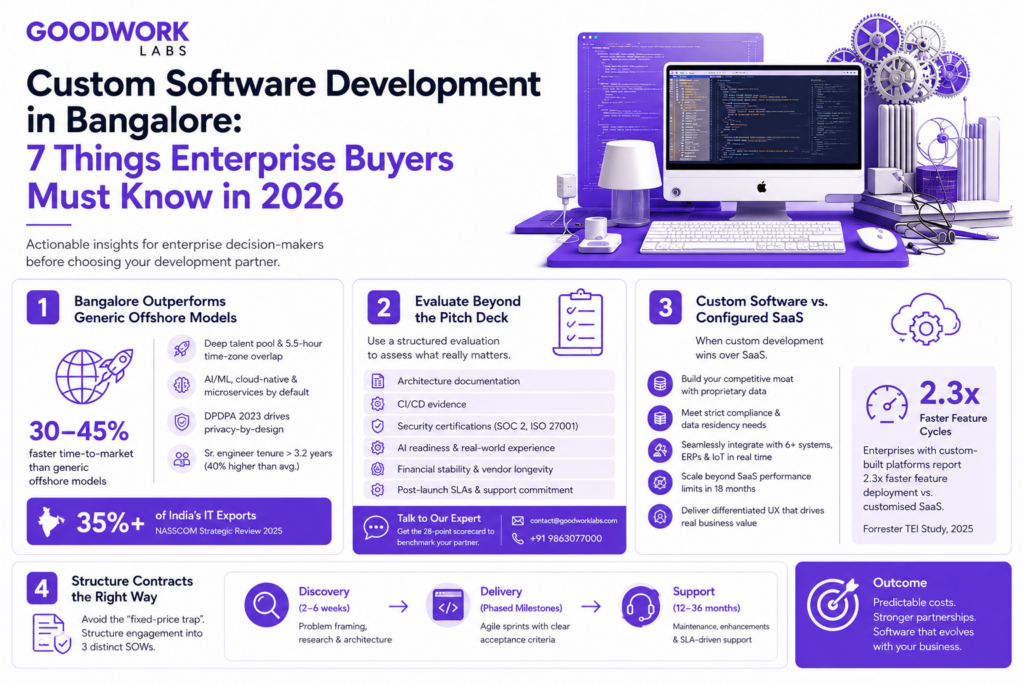
Bangalore-based custom development delivers 30–45% faster time-to-market than comparable offshore projects in Eastern Europe or Southeast Asia, primarily because of the city’s density of full-stack engineering talent and its 5.5-hour time-zone overlap with Gulf, African, and South-East Asian buyers.
Unlike a generic offshore software development service that ships feature factories, Bangalore’s top engineering firms operate closer to product studios embedding architects, UX researchers, and QA engineers from day one. The result is software that survives production at scale, not just demo environments.
Key differentiators in 2026:
- Over 1,200 funded startups generate constant competitive pressure on engineering quality
- Fluency in AI/ML, cloud-native, and microservices architectures is now industry-standard, not premium
- India’s Digital Personal Data Protection Act (DPDPA) 2023 has pushed Bangalore firms to build privacy-by-design into every engagement
- Average senior engineer tenure at established firms exceeds 3.2 years 40% higher than pan-India average
35%+ of India’s IT Exports
Bangalore accounts for over 35% of India’s total IT exports, with custom product development as the fastest-growing sub-segment in 2025–26.
NASSCOM Strategic Review 2025
How Do You Evaluate Top Software Development Services Beyond the Pitch Deck?
Evaluating top software development services requires moving past slide decks and into architecture reviews, code audits, and reference calls with live clients not the curated references vendors pre-select.
Enterprise buyers consistently cite three failure modes: scope ambiguity in MSAs, inadequate DevOps maturity, and insufficient post-launch SLAs. Here is a structured evaluation framework that filters for all three:
Vendor Assessment Checklist for 2026
- Architecture documentation: Request a past system design document not a generic template
- CI/CD evidence: Ask for pipeline screenshots or a live demonstration in a sandbox environment
- Security posture: Verify SOC 2 Type II, ISO 27001, or equivalent certifications rather than self-declarations
- AI readiness: Confirm the team has shipped at least one LLM-integrated or agentic workflow in production
- Financial stability: For engagements over ₹2 Cr, request audited accounts vendor longevity protects your roadmap
- Post-launch commitment: SLA response times, bug severity matrix, and escalation paths should be contractual, not conversational
A vendor who hesitates on any of the above is signalling a gap they would rather you not discover before signing.
Get the 28-point scorecard GoodWork Labs uses internally to benchmark software delivery partners.
Contact GoodWork Labs: contact@goodworklabs.com | +91 9863077000
What Makes a Customized Software Solution Different from a Configured SaaS Product?
A customized software solution is built around your business logic, data model, and integration landscape not a vendor’s predefined feature set. This distinction is critical because enterprises consistently underestimate the total cost of bending SaaS products to fit proprietary workflows.
Studies by Gartner and IDC consistently show that 60–70% of enterprise SaaS projects require significant customisation and once you have customised a SaaS product beyond its intended use, you inherit its upgrade risk, licensing costs, and vendor lock-in simultaneously.
When Custom Development Wins Over SaaS
- Your competitive moat depends on proprietary data flows that cannot be replicated in a shared-tenant environment
- Regulatory requirements (SEBI, RBI, HIPAA, DPDPA) mandate data residency or audit trails that SaaS platforms cannot guarantee
- You need to integrate with 6+ legacy systems, ERPs, or IoT data streams in real time
- Projected scale exceeds the SaaS vendor’s performance benchmarks within 18 months
- Customer-facing UX differentiation is a core product strategy not just an aesthetic preference
At GoodWork Labs, roughly 65% of enterprise clients approach us after a failed or stalled SaaS implementation the switch to a customized software solution invariably unlocks the workflow flexibility they needed from day one.
2.3× Faster Feature Cycles
Enterprises that invested in custom-built core platforms reported 2.3× faster feature deployment cycles compared to heavily customised SaaS alternatives.
Forrester Total Economic Impact Study, 2025
How Should Enterprise Buyers Structure Contracts for Custom Development Services in Bangalore?
Contracts for custom development services in Bangalore should separate discovery, delivery, and support into distinct SOWs not bundle them into a single fixed-price agreement. This structure protects both parties and aligns incentives across the engagement lifecycle.
The most common commercial pitfall in 2025–26 has been the “fixed-price trap”: buyers lock in a price before requirements are fully understood, vendors cut corners to protect margins, and the relationship deteriorates before the first production release.
Recommended Contract Architecture
- Phase 1 — Discovery Sprint (2–4 weeks, capped T&M): Architecture blueprint, data model, integration map, and sprint-zero backlog
- Phase 2 — Delivery (milestone-based fixed price OR time-and-material with sprint velocity KPIs)
- Phase 3 — Stabilisation (30–90 day warranty period with defined bug severity SLAs at no additional cost)
- Phase 4 — Managed Support (retainer-based, with clear escalation paths and on-call commitments)
IP assignment clauses deserve particular scrutiny: confirm that all source code, documentation, and third-party licences are fully transferred to you upon final payment not staged over a retention period that creates leverage for the vendor.
Currency of payment, GST applicability (18% for software development services), and TDS obligations under Section 194J should be resolved with your finance team before LOI, not after.
Which Technologies Are Bangalore’s Top Software Development Teams Specialising in for 2026?
Bangalore’s leading software development service providers in 2026 are concentrating capability around three core technology pillars: AI-native application development, cloud-native distributed systems, and cross-platform mobile engineering often combined within a single product delivery.
The shift is structural, not cyclical. Generative AI and agentic frameworks have collapsed the cost of certain mid-complexity features by 40–60%, freeing engineering bandwidth for architecture, security hardening, and observability the areas where senior Bangalore talent genuinely differentiates.
Technology Stack Priorities — Enterprise Demand in 2026
- AI/ML Integration: LLM fine-tuning, RAG pipelines, agentic workflows (LangChain, CrewAI, LlamaIndex)
- Cloud-Native Backend: Go, Rust, Node.js microservices on AWS/GCP/Azure with Kubernetes orchestration
- Modern Frontend: React, Next.js, Flutter for cross-platform (web, iOS, Android) from a single codebase
- Data Engineering: Real-time pipelines (Kafka, Flink), vector databases (Pinecone, Weaviate), and lakehouse architectures
- DevSecOps: Shift-left security, SAST/DAST pipelines, SBOM generation for regulatory audit trails
- Edge Computing: IoT-adjacent enterprise use cases particularly logistics, manufacturing, and smart-building clients
At GoodWork Labs, our AI/ML Development practice has grown to represent over 40% of new enterprise engagements in 2025–26, reflecting the market’s decisive pivot toward intelligent, data-driven application layers.
Let’s Review Your Technology Stack
Book a free 60-minute architecture consultation with a GoodWork Labs principal engineer. No sales pitch — pure technical review.
Contact GoodWork Labs
What Are the Real Costs of Custom Software Development in Bangalore in 2026?
Custom software development costs in Bangalore typically range from ₹25 lakh to ₹5 crore+ depending on complexity, team size, and engagement duration but the figure that matters most to enterprise CFOs is total cost of ownership (TCO) over 36 months, not the initial development invoice.
A common buyer mistake is optimising for the lowest-cost proposal rather than the highest-value delivery team. An MVP that ships 40% under budget but requires a full re-architecture in 18 months costs 2–3× the original quote by year two.
Cost Benchmarks by Engagement Type (2026)
- MVP / Proof of Concept: ₹15–40 lakh | 2–4 months | 3–6 person team
- Enterprise Web or Mobile Platform: ₹50 lakh–1.5 crore | 4–8 months | 6–12 person team
- AI-Native Application (LLM-integrated, production-grade): ₹80 lakh–2 crore+ | 5–10 months
- Large-Scale Digital Transformation (multi-system, multi-market): ₹2–5 crore+ | 10–24 months
- Staff Augmentation (per engineer/month): ₹1.8–4.5 lakh depending on seniority and specialisation
Hidden cost drivers buyers frequently overlook include third-party API licensing, cloud infrastructure provisioning, compliance audit fees, user acceptance testing (UAT) cycles, and change management budget 15–25% of development cost for these.
GoodWork Labs provides open-book pricing with itemised cost breakdowns from discovery sprint. Our clients consistently report that transparency at the estimation stage prevents the scope escalations that inflate final invoices.
How Do You Ensure Long-Term Success with a Bangalore Software Development Service Partner?
Long-term success with a software development service partner depends on governance cadence, knowledge transfer protocols, and contractual continuity not just technical delivery. The relationship structure you establish in week one determines outcomes in year three.
Enterprise buyers who report the highest satisfaction scores share a consistent pattern: they treat their development partner as an embedded product team rather than a feature vendor. This means joint sprint planning, shared OKRs, co-ownership of technical debt reduction, and proactive architecture reviews every quarter.
Governance Framework for Multi-Year Engagements
- Weekly: Sprint reviews with product owner attendance not just development team reports
- Monthly: Engineering health metrics review (test coverage, incident rate, deployment frequency, DORA metrics)
- Quarterly: Architecture roadmap alignment and technology refresh assessment
- Annually: Contract renegotiation tied to delivery performance KPIs, not just tenure
Knowledge transfer is non-negotiable. Insist on living documentation (Confluence, Notion, or equivalent) updated at every sprint close, and conduct a structured handover drill at month 6 even if you never intend to switch vendors. The exercise surfaces knowledge silos before they become risks.
GoodWork Labs ranked by Deloitte and trusted by 32+ unicorns operates on a model where client engineering teams can independently operate, extend, and audit every system we build. Our definition of delivery excellence includes the day you no longer need us.
Ready to Start Your Custom Software Project in Bangalore?
GoodWork Labs has delivered production-grade platforms for 32+ unicorns. From AI-native applications to large-scale digital transformation, our team brings architecture-first thinking and transparent delivery to every engagement.
📧 contact@goodworklabs.com 📞 +91 9863077000 🌐 goodworklabs.com