
Hiring world-class engineering talent has become increasingly complex and expensive. In 2026, enterprises face rising developer salaries, longer hiring cycles, and intense competition for specialized technical skills.
Because of this, many organizations are shifting toward staff augmentation services as a strategic hiring alternative.
But the real question decision-makers ask is:
How much money can enterprises actually save by using staff augmentation instead of hiring full-time engineers?
Industry research suggests that organizations can reduce engineering costs by 35%–60% while maintaining productivity and delivery speed through staff augmentation.
In this guide, we break down the true cost of full-time hiring, compare it with augmented teams, and introduce a practical ROI calculator framework to help enterprises make smarter workforce decisions in 2026.
What Is Staff Augmentation? (A Quick Definition for Enterprise Leaders)
Staff augmentation is a hiring strategy where organizations extend their internal teams with external engineers, designers, or specialists on demand. Unlike outsourcing projects completely, staff augmentation allows companies to maintain direct control over development workflows while accessing specialized global talent.
Enterprises increasingly adopt staff augmentation services because they offer:
-
Faster access to highly skilled developers
-
Flexible team scaling for projects
-
Lower operational risk compared to permanent hiring
Technology leaders often use this model to fill temporary skill gaps or accelerate product development cycles without increasing long-term headcount.
Companies such as GoodWorkLabs help enterprises access experienced developers, AI engineers, mobile specialists, and DevOps experts through flexible augmentation models tailored to product roadmaps.
Expand Your Engineering Team Faster
Access enterprise-grade developers through GoodWorkLabs staff augmentation services and scale your product team without long hiring delays.
The True Cost of Full-Time Engineering Hiring (Beyond Salary)
Many organizations evaluate hiring costs based only on base salary, but the real cost of a full-time engineer is significantly higher.
Hidden expenses include recruitment, infrastructure, benefits, and lost productivity during onboarding.
Recruitment & Onboarding Costs
Hiring senior developers is both time-intensive and expensive. Average enterprise hiring metrics in 2026:
| Metric | Average |
| Time to hire | 45–70 days |
| Recruitment agency fees | 20–30% of salary |
| Internal hiring costs | $4,000–$8,000 |
For example:
If an enterprise hires a senior engineer earning $140,000 annually, recruitment fees alone may reach $28,000–$35,000.
Additional onboarding expenses include:
-
HR onboarding processes
-
internal training programs
-
technical setup and documentation
These onboarding costs often add $5,000–$10,000 per hire.
Benefits, Taxes & Overhead
Full-time hiring also includes employer obligations such as:
-
health insurance
-
retirement contributions
-
payroll taxes
-
office infrastructure
-
hardware and development tools
These additional costs typically increase salary expenses by 30–45%.
Example breakdown:
| Cost Component | Estimated Cost |
| Base salary | $140,000 |
| Benefits & payroll taxes | $50,000 |
| Infrastructure & tools | $10,000 |
| Total annual cost | $200,000+ |
Ramp-Up Time and Lost Velocity
Even highly experienced developers require time to understand internal systems.
Typical ramp-up timeline:
-
Month 1–2 → onboarding and documentation
-
Month 3–4 → partial productivity
-
Month 5 → full contribution
This ramp-up phase can reduce engineering output for months, especially in complex enterprise environments. When product timelines are tight, delayed productivity can significantly impact time-to-market and revenue opportunities.
Staff Augmentation Cost Breakdown: What You Actually Pay
Unlike traditional hiring, staff augmentation services focus on productive development hours rather than employment overhead. Organizations pay only for active engineering contribution, eliminating several hidden costs.
These models remove expenses such as:
-
recruitment fees
-
long-term benefits
-
idle bench resources
Hourly vs. Monthly Engagement Models
Most augmentation engagements operate under two common pricing models.
Hourly Engagement
Best suited for:
-
short-term technical consulting
-
performance optimization
-
specialized expertise
Typical hourly rates:
| Region | Rate |
| India | $25–$60 |
| Eastern Europe | $45–$90 |
| LATAM | $40–$80 |
Dedicated Monthly Teams
Many enterprises prefer dedicated teams for ongoing development.
Example monthly developer cost:
| Region | Monthly Cost (Senior Developer) | Annual Equivalent |
vs. US FTE ($230K)
|
| India | $4,500 – $8,000 | $54K – $96K | Save 58–76% |
| Eastern Europe | $8,000 – $14,000 | $96K – $168K | Save 37–63% |
| LATAM | $7,000 – $12,000 | $84K – $144K | Save 27–58% |
| North America (US/Canada) | $16,000 – $25,000 | $192K – $300K | $192K – $300K |
This cost difference explains why global organizations increasingly rely on staff augmentation services to expand engineering teams efficiently.
Rates vary based on seniority, tech stack specialization, and engagement duration. Figures reflect 2026 market benchmarks for full-time equivalent augmentation.
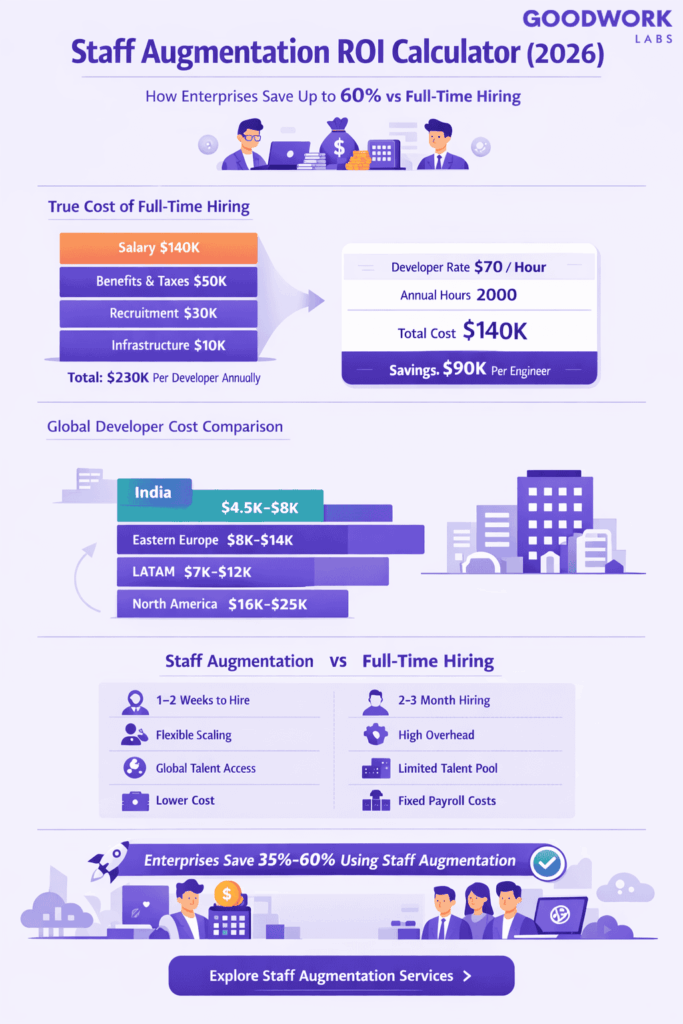
India vs. Eastern Europe vs. Latam: Rate Comparison
India remains one of the most preferred destinations for engineering augmentation because of:
-
strong STEM education ecosystem
-
large developer workforce
-
globally competitive pricing
Companies like GoodWorkLabs combine these advantages with enterprise delivery standards, helping organizations access reliable engineering talent quickly.
Staff Augmentation ROI Calculator [Interactive Tool]
Enterprises often use a simple framework to estimate the financial benefits of augmentation.
Step 1: Calculate Full-Time Hiring Cost
Example cost for one senior developer:
| Expense | Amount |
| Salary | $140,000 |
| Benefits & taxes | $50,000 |
| Recruitment | $30,000 |
| Infrastructure | $10,000 |
| Total cost | $230,000 |
Step 2: Calculate Augmented Team Cost
Example scenario:
| Expense | Amount |
| Developer rate | $70/hour |
| Annual hours | $2,000 |
| Total cost | $140,000 |
Step 3: Calculate Savings
Annual savings per engineer:
$230,000 – $140,000 = $90,000
That represents ~39% cost savings per developer annually.
For a team of 10 engineers, this could exceed $900,000 in yearly savings.
This is one of the main reasons enterprises increasingly adopt staff augmentation services when scaling development capacity.
Head-to-Head Comparison: Staff Aug vs. Full-Time Hire
| Factor | Staff Augmentation | Full-Time Hiring |
| Hiring speed | 1–2 weeks | 2–3 months |
| Cost structure | Flexible | Fixed |
| Scalability | On-demand | Limited |
| Access to global talent | Yes | Usually local |
| Operational risk | Lower | Higher |
For enterprises under pressure to deliver faster, augmentation often provides greater agility and financial efficiency.
When Staff Augmentation Delivers the Highest ROI
The financial advantages of augmentation are strongest in situations requiring rapid scaling and specialized expertise.
Scaling for a Product Launch
Before launching a product, engineering teams often need temporary capacity increases. Using staff augmentation services allows companies to scale quickly without committing to permanent hiring.
Bridging a Skill Gap Mid-Sprint
Specialized skills such as AI engineering, DevOps automation, or blockchain development may not exist internally. Augmented specialists help teams solve complex challenges without long recruitment cycles.
Reducing Bench Costs Post-Delivery
After completing major releases, companies often face idle development resources. With augmentation models, organizations can reduce team size immediately and optimize operational budgets.
Hidden Costs Enterprises Overlook in Both Models
Regardless of hiring approach, enterprises must account for operational factors such as:
-
communication alignment
-
project management processes
-
security compliance
Working with experienced providers ensures smoother integration.
GoodWorkLabs addresses these challenges by offering:
-
experienced project managers
-
secure development infrastructure
-
collaborative workflows that integrate with internal teams
These capabilities help enterprises maximize the ROI of staff augmentation services.
Staff Augmentation ROI by Company Stage
The value of augmentation varies depending on company maturity.
Startups
Startups benefit from:
-
reduced hiring costs
-
faster MVP development
-
access to experienced engineers
Scale-Ups and Mid-Market
Growing companies often use augmented teams to:
-
expand product features rapidly
-
support multiple development streams
-
accelerate product innovation
Enterprise (500+ Employees)
Large enterprises rely on augmentation to support:
-
digital transformation initiatives
-
modernization of legacy systems
-
innovation labs and experimental projects
These organizations frequently partner with providers like GoodWorkLabs to access specialized engineering capabilities through flexible staff augmentation services.
How to Choose the Right Staff Augmentation Partner
Selecting the right partner significantly impacts project success.
Key factors to evaluate include:
Technical expertise
Look for providers experienced in:
-
cloud and DevOps
Talent quality
Reliable augmentation partners ensure developers have:
-
strong technical evaluations
-
enterprise project experience
-
ability to collaborate with distributed teams
Delivery capability
GoodWorkLabs stands out for its:
-
award-winning engineering teams
-
experience delivering 100+ digital products
-
expertise across mobile apps, AI platforms, and enterprise systems
These strengths make it a trusted partner for organizations seeking scalable engineering talent.
Conclusion
Enterprises in 2026 must balance speed, innovation, and cost efficiency while building high-performing engineering teams. Traditional hiring models often struggle to meet these demands due to long recruitment cycles and high operational costs.
By leveraging flexible workforce strategies, organizations can:
-
reduce development costs
-
access specialized expertise
-
scale engineering teams faster
For companies looking to expand their technical capabilities, GoodWorkLabs provides reliable staff augmentation services designed for modern enterprise needs.
Ready to Reduce Engineering Costs?
Partner with GoodWorkLabs to build scalable engineering teams and accelerate digital innovation.