
 AI & ML Advisory Services
 Software Development
 Staff Augmentation
 DevOps Consulting Services
 Digital Transformation
 Talent And RPO Solutions
 Artificial Intelligence
 UX Design Studio
 Robotic Process Automation
 Global Capability Center(GCC)
 Platform Strategy
 Cloud Services
 Mobile App Development
 Games Development
 IOT Application Development
 Corporate Training Services
AI/ML advisory services are no longer optional in 2026 they are becoming the fastest path for enterprises to move from AI ambition to real, measurable business outcomes. As organizations race to deploy machine learning, generative AI, and intelligent automation at scale, a critical question keeps surfacing:
Should enterprises rely on AI/ML advisory services and external expertise, or build and scale in-house AI teams?
The answer is no longer black and white. What matters in 2026 is execution speed, governance maturity, ROI clarity, and production reliability. This blog breaks down both models, compares outcomes, and explains why a hybrid, advisory-led approach is delivering superior results for most enterprises especially when supported by experienced partners like GoodWork Labs.
Why AI outcomes matter more than AI adoption in 2026
Enterprises today are not struggling with AI awareness. They are struggling with:
-
AI pilots that never reach production
-
Models that fail in real-world conditions
-
Poor data readiness and fragmented architecture
-
Lack of governance, explainability, and ownership
In 2026, leadership teams are shifting focus from “Do we have AI?” to “Is AI improving revenue, efficiency, or decision-making?”
This shift is exactly where AI/ML advisory services create value by aligning AI initiatives with business priorities, execution discipline, and operational maturity.
What AI/ML advisory services really mean in 2026
Modern AI/ML advisory services go far beyond strategy decks or isolated consulting engagements. They combine advisory thinking with hands-on delivery and enterprise execution.
A mature AI/ML advisory engagement typically includes:
-
AI opportunity discovery aligned to business KPIs
-
Data readiness and architecture assessment
-
AI roadmap creation with phased execution
-
AI/ML development services for real use cases
-
MLOps setup for deployment, monitoring, and lifecycle management
-
Governance frameworks for responsible and compliant AI
GoodWork Labs delivers AI/ML advisory services with a strong emphasis on production-grade systems, enterprise security, and measurable outcomes helping organizations move confidently from concept to scale.
Understanding in-house AI teams: strengths and limitations
Building an in-house AI team gives enterprises control, long-term ownership, and deeper institutional knowledge. However, successful in-house AI teams require far more than hiring a few data scientists.
A fully functional in-house AI capability needs:
-
Data engineers for pipelines and quality
-
ML engineers for scalable model deployment
-
Data scientists for experimentation and modeling
-
MLOps engineers for monitoring and retraining
-
Product and domain experts for adoption
-
Governance and security alignment
The biggest challenge is not talent availability alone it’s time to maturity. Many enterprises underestimate how long it takes to build reliable AI systems that work in production, under real business constraints.
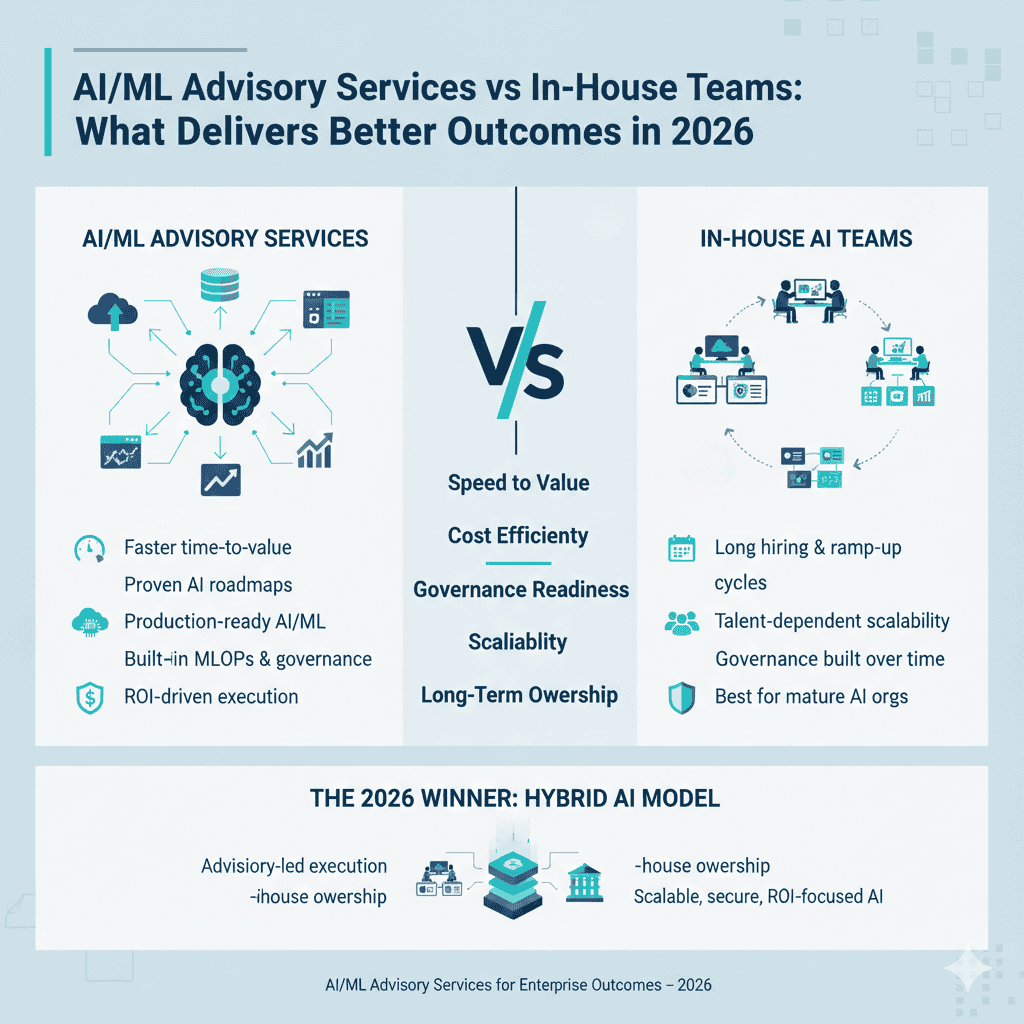
AI/ML advisory services vs in-house teams: a 2026 outcome comparison
1. Speed to value
AI/ML advisory services clearly outperform when speed matters.
Advisory teams bring:
-
Pre-built accelerators
-
Proven delivery frameworks
-
Cross-industry experience
-
Immediate access to senior expertise
In contrast, in-house teams often spend months on hiring, onboarding, and alignment before delivering their first production model.
If your business goal is to deliver AI outcomes within a quarter, advisory-led execution wins.
2. Cost efficiency and ROI clarity
While in-house teams may appear cheaper initially, hidden costs accumulate:
-
Recruitment delays
-
Tooling and experimentation waste
-
Rework due to architectural mistakes
-
Governance and compliance retrofitting
AI/ML advisory services, especially when paired with targeted AI/ML development services, reduce wasted effort by focusing only on high-impact use cases with clear ROI paths.
The result is often lower total cost of ownership over the first 12–18 months.
3. Production readiness and MLOps maturity
AI fails most often at the production stage.
Advisory-led teams prioritize:
-
Model monitoring and drift detection
-
CI/CD pipelines for ML
-
Retraining strategies
-
Incident response workflows
Many in-house teams struggle here because MLOps expertise is rare and expensive. Without strong MLOps foundations, AI systems degrade silently, eroding trust and value.
This is where AI/ML advisory services consistently outperform early-stage in-house setups.
4. Governance, security, and responsible AI
In 2026, AI governance is no longer optional.
Enterprises must manage:
-
Model explainability
-
Data privacy and access control
-
Bias and fairness
-
Regulatory compliance
-
Accountability for AI decisions
Advisory partners like GoodWork Labs embed governance and responsible AI practices from day one, rather than treating them as afterthoughts.
In-house teams can achieve this but usually after painful lessons and delayed rollouts.
5. Long-term ownership and competitive differentiation
This is where in-house teams shine.
If AI is core to your product or competitive moat, building internal capability is essential. However, the most successful organizations do not start alone.
They use AI/ML advisory services to:
-
Design the AI operating model
-
Establish technical foundations
-
Train internal teams
-
Transfer execution ownership gradually
This hybrid approach delivers speed now and autonomy later.
The hybrid model: the winning strategy in 2026
For most enterprises, the best outcomes come from combining AI/ML advisory services with in-house ownership.
A typical hybrid model looks like this:
-
Advisory team leads strategy, architecture, and initial delivery
-
AI/ML development services accelerate production use cases
-
Internal teams shadow, learn, and gradually take ownership
-
Governance and MLOps standards are institutionalized early
This model minimizes risk, shortens time-to-value, and builds sustainable AI capability.
Why enterprises choose GoodWork Labs for AI/ML advisory services
GoodWork Labs stands out because it focuses on execution, not experimentation.
Their AI/ML advisory services are designed for enterprises that want:
-
Business-aligned AI roadmaps
-
Scalable and secure AI architecture
-
Production-ready AI/ML development services
-
Strong MLOps and governance foundations
-
Measurable business impact, not just models
GoodWork Labs works closely with leadership, technology, and operations teams to ensure AI solutions are adopted, trusted, and scaled responsibly.
How to decide what’s right for your organization
Choose AI/ML advisory services if:
-
You need results within 90 days
-
Your AI initiatives are stuck at PoC stage
-
You lack MLOps or governance maturity
-
You want ROI-driven execution
Choose in-house teams if:
-
AI is your core product differentiator
-
You already have strong data and platform foundations
-
You can invest in long-term talent development
Choose a hybrid model if:
-
You want fast outcomes now and ownership later
-
You need expert guidance while building internal capability
-
You want to reduce risk while scaling AI responsibly
Conclusion
In 2026, success is not about choosing between AI/ML advisory services and in-house teams. It’s about choosing the right execution model for your maturity, goals, and risk tolerance.
For most enterprises, advisory-led, hybrid execution powered by strong AI/ML development services delivers faster, safer, and more sustainable outcomes.
Schedule a strategic AI/ML advisory consultation with GoodWork Labs