

Virtual Reality applications in boosting confidence

Virtual Reality to Practical Confidence.


“People think every creative idea possible has already happened, unfortunately, technology is greedy, it wants more.”


In this hotchpotch of a world that we live in, sometimes some souls lack behind in certain basic skills such as communication and decision-making. It is either due to lack of exposure or hereditary to put it in simpler terms. Most of us are afraid of the stage or fear facing a huge crowd. And some of us live with that fear forever, protecting ourselves in a cocoon not realizing how it affects our overall growth. It is not just the basic skills that need confidence. It can be your professional skills as well. And it is time proven that confidence can only be harnessed through practice and gaining experience.

Virtual reality is capable of stimulating experiences in our mind that as of now no other tech can match up to. It can virtually make you face your worst fears and teach you to cope with them. VR can fool your mind that you’re already well versed with something which you may or may not have experienced in reality.

Let us discuss 7 possibilities on how VR can train the mind:


1. Medical Training: Medical students can now perform surgical procedures on live 3D models of the human body instead of corpses till they perfect the procedure. They will get a hands-on experience with virtual patients and emergency cases. This will result in medical professionals with experience and embedded with confidence.
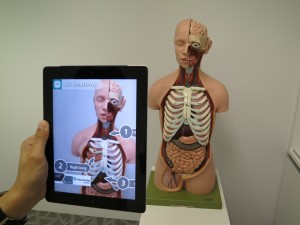
Virtual Reality App- Medical Training


2. Stage fear: There are already mobile apps that let you practice in front of a virtual audience in your choice of environment. From best man speeches, lectures and interactive talks, you can practice them beforehand and be more confident at delivering your words. Soon, there will be Tedx talk environments for the enlightened ones as well.

Virtual Reality App - Stage Fear


3. Meditation: Imagine meditating in the middle of a forest under a banyan tree sitting on a couch. Virtual reality can take you anywhere you want, with minimal noise and utmost peace. Stimulating the senses in such an environment can calm our emotional facade.

Virtual Reality App - Meditation


4.Therapy: Stress and mental fatigue can break down anyone. Virtual reality can provide relief to the affected by psychologically planned scenarios, creating a therapeutic environment or interacting with a long distanced loved one in a VR environment.

Virtual Reality App - Therapy


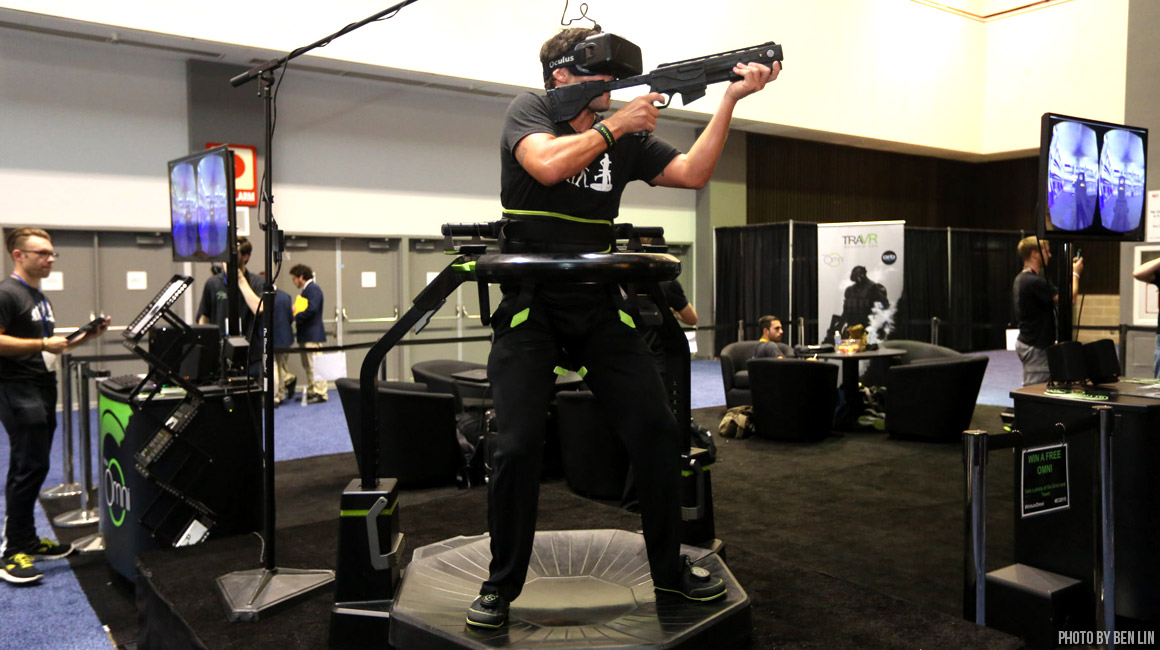
5. Military Training: A trainee soldier or a trainee pilot can now experience real-life attack scenarios and respond accordingly. The military will save tremendously on their training costs and in turn, will gain soldiers who are ready for the brunt of their profession.

Virtual Reality App- Military Training


6. Sports: Virtual Reality can entirely change the way a batsman, footballer, athlete or a race car driver practices. It can simulate different environments, difficulty and fatigue levels to keep the players geared up for the action by enhancing their confidence levels.

 

Virtual Reality App - Sports


7. Surrealism: Sometimes, all we need is time by ourselves. It is a proven fact that solitude once in a while can do wonders. Virtual reality can set up an environment of your choice, on a beach, on the top of a hill or just floating in the outer space. This will immensely help you feel better and drive your productivity sky high.


Virtual Reality App - Surrealism

Escaping reality is not a bad idea, in fact, it is one of the best ideas mankind has had. Right from books, media, and gaming, we have been constantly evolving ourselves to diverge from reality for a few moments. And when technology is in our hands, why not use it and improve our personality, stimulate our minds for an improved performance and in the overall process boost our confidence.

Hiring for iOS Developers

A Career Drive in Bangalore that you must attend!

Are you passionate about technology?

Are you an engineer who wants to create awesome products?

We want you!

GoodWorkLabs is running a massive career drive to head-hunt the most talented iOS Developers!

Just walk-in with your resume and WOW us with your exceptional coding skills!

Drive details:

Date: 4th March | Saturday

Time: 9.30 am to 2.00 pm

Venue: GoodWorkLabs, 4th floor Akshay Tech Park, EPIP Zone, Whitefield.

Experience:

  • Minimum 2.5 years of over-all software development experience
  • 6 months of SWIFT experience is a must.
  • Location: Bangalore

Skill Sets:

  • BE/B.Tech/ME/M.Tech in Computer Science.
  • Experience of iOS development with expertise in Objective C frameworks
  • Strong fundamentals in Computer Science
  • Working knowledge of the general architectures, trends, and emerging technologies in app development
  • Excellent communication skills (verbal and written) to interact with various departments locally and internationally
  • Desirable to have published one or more iOS apps in the app store.
  • Write code and review code .
  • Strong client interaction /Delivery Management

Responsibilities:

  • Design and develop applications for the iOS platform
  • Collaborate with cross-functional teams to define, design, and implement new features.
  • Work on bug fixing and improving application performance
  • Continuously discover, evaluate, and implement new technologies 

If you are a technical architect who wants to fast-track your career, then GoodWorkLabs is the place to be!

If you are based out of Bangalore, but are still interested in a career with GoodWorkLabs, then send us your resume on careers@www.goodworklabs.com


See you on the inside!

How to be a strong willed UX designer?

Challenges for a UX Designer


According to LinkedIN, there are 900,000 UX designers in the world. How strong willed are you to be one of the best in the long run?

“ Determination is the wake up call to the human will”

A designer is a commercial artist confined by factors such as economical efficiency, technological constraints and most importantly a client’s requirements.  A UX designer is more skilled in the techniques and the process on a whole new level which we will not dwell into. And as seen with artists and designers, even UX designers can lose their way in between or simply succumb to mental fatigue unless the work flow is organised and their creative persona is kept alive.

So, what exactly are the obstacles a UX designer faces?

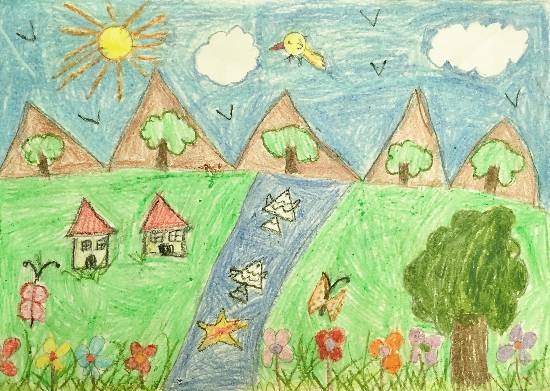
To answer the above question, let us just assume you are 6 years old and in elementary school. The task at hand in the art class is to draw the conventional scenery with a sunrise and a small house.


Basics of UX designing


You have an hour to complete the task and your creative and young mind sketches out generously on the canvas. Agreed, it will not be the best work of art but for a 6 year old child, it is commendable.

Now, let us add factors one by one to transform the 6 year child into a UX designer.

  1. The client, the teacher in this case, wants an enhanced amalgamation of colors that are soothing to the eye.

  2. Instead of crayons, you will use the latest tech available to make it more interactive: the fish in the rivers should pop out when touched, the canvas should have interchangeable themes according to the time of the day and everything should look lifelike.

  3. Instead of an hour, you have a week, in which you have to start from the scratch. Create a storyboard, research how different users react to the design, predict how users are going to interact with the picture on different levels to name a few.

  4. And now, most importantly, you are not supposed to cross a fixed budget, redraft the design until the client likes it and stick to a deadline.

  5. You’re in your 20’s now, you have had experiences as a human being and your creative side sometimes has a slightly different point of view.

And thus begins the constant battle between your creativity and someone’s exact requirements. Being a 6 year old was fun, being a UX designer is much more fun stacked up on a heap of obstacles and opportunities. So, how to go through the ardent process while enjoying it and keeping your creative ego on a standby?

Remember:

You are special. You are sketching the future of technology. It is a part of you that people will see when they access the digital world. You have already predicted what they will feel, how they will react and that is nothing but pure magic! Not an illusion, not a cheap trick, but a result of your skills and ingenuity. So, as far as you keep this in mind and adjust to a few requests, you are already strong willed to be one of the best in UX designing.

Still, here are a few tips to keep yourself clutter free and determined:

  1. Ask yourself why is the client/business spending money on UX design? If it is so important can I afford to lag behind and deliver an under-performing product?

  2. It is good to have infinite concepts for a project but stick to a concept, believe in it and keep refining it. The more choices you have, the more fatigue you will experience even before starting especially when you have a deadline.

  3. When we are unsure of what to do, we usually look towards a social behavior to guide us. Avoid that. It is your design, a proof of your brilliance.

  4. People not only perceive object shapes better, they respond better to action oriented stimuli. Allow this thought process in your creativity.

  5. Be clear of what exactly you want from your design, see your design on an emotional level for the future user.

  6. Every process has its hardships, but visualize the end result that will boost your confidence.

  7. Anything beautiful and alleviating takes time and effort to be created. It is your mind, your space and your canvas. Realize it proves your worth as a person and as a professional.

  8. Divert your mind from social and family matters and engage in healthy conversations with your co-workers.


Being a UX designer, perhaps no one will ever know who designed the masterpiece android/iOS mobile app that they have gotten addicted to. You are designing for everyone and no one at the same time. Either your passion for designing and challenges provide the spark for you or it is the growth opportunities. There will be times when you will be agitated, every creative soul goes through that. In fact it is imperative. All that pressure, all those suggestions and yet every time if you come up with a design that startles everyone, you will be the silent guardian that ensures the success of products.

A creative knight in the shining armor of technology.


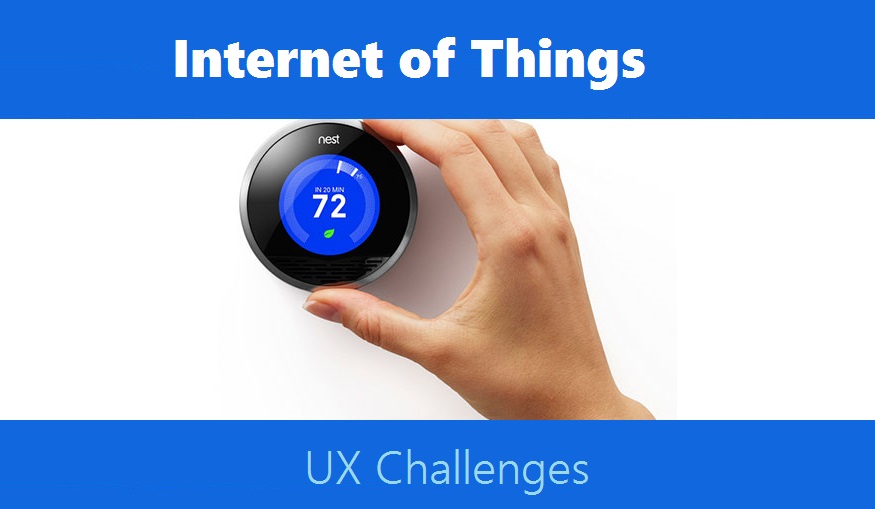
5 UX Challenges With Internet of Things (IoT)

In the emerging trends, Internet of Things (IoT) is the most discussed technology that has impressed users across the globe by transforming the way they complete their daily tasks. As per Juniper’s recent report, the IOT connected objects, sensors, devices, and actuators are expected to reach over 46 billion in 2021(approximately.) Since a lot of new advancements will be experienced in ‘smart’ devices, apps and products, UX designers may experience various challenges while coping up their products and services with this technology. Read the article below to know about some current problems that every UX designer is facing while making products and services available for the future:

1.     Challenges While Designing the Application

It is important to keep in mind while creating IoT products that they are the dumbest versions of modern devices. Incorporating artificial intelligence and an argument for adopting the change are the two prime concerns that aren’t easy to resolve. Product designers may get stuck while crafting something that can work as per the main functioning of an application.

2.     Usability Concerns

IoT is automating monotonous tasks to enhance user efficiency and effectiveness. One of the biggest challenges a user experience designer faces is – IoT being in its infancy stage. Since no OEM has developed a product individually, most of the marketed gadgets lack usability. Another major constraint is that these products aren’t using traditional approach because the current knowledge and experience aren’t applicable at all. Gadgets can be only optimized and improved basis research, and it will take some time.

5 UX challenges for iOT

3.     Device Connectivity – Are We Prepared?

If IoT is the future, then it is imperative to consider that the future devices will be of no use if they aren’t connected to the network. Since the entire process works on transferring data without human intervention, it becomes a mandate for users to stay connected over the same network. Laptops and Smartphones facing network issues is quite common, what if your hundred dollars smart device also displays the same error? The biggest question is – are we ready for this? The answer is No. Developers will require discovering newer ways to handle such situations on IoT devices as they won’t be online all the time.

4.     Glitches – Something You Can’t Ignore

The IoT brings new and exceptional challenges for UX designers. We are entering the world where the poor web or mobile UX may survive, but the poorly functioning smart object with delayed experience could be problematic. A burnt toast or breakfast will never be welcomed with a pleasing smile; however, a delayed web page experience can be tolerated for some time.

5.     UX Should Be a Priority

While making products for the future, the user experience designing should be the priority because a single issue in the product or its features may ruin the entire experience. The principle for designing IOT’s product is – make it work, incorporate efficiency, add security, and bring on the innovations.

Conclusion

Working on the core principles of ensuring task handling processes faster and comfortable, the technology is creating endless possibilities for making everything connected over an app. Since many users may not adopt IoT empowered devices quickly, designers and manufacturers must incorporate certain features in them to compel users for choosing the smart devices over traditional ones.

Top Five Trends in Enterprise Mobility To Look Out For in 2017

The popularity of enterprise mobility can be easily recognized from the fact that about 71% of the organizations consider mobility as their number one priority. According to an estimate by Nasscom, the global market for enterprise mobility is approximately valued at $140 billion annually by the year 2020. It is not a surprise at all to see this encouraging adoption of enterprise mobility services by companies irrespective of scale or size, considering that it can save almost 240 hours per employee.

Top_5_Enterprise_Mobility_trends_in_2017

But, it is also important to note that this is an emerging technology with the space being extremely fluid. Every other day, new paradigm seems to be emerging. Check out these top five trends in enterprise mobility for 2017 to ensure that you are on the right track with your mobility integration programme.

1.     Artificial Intelligence features likely to go mainstream

You must be aware that AI or Artificial Intelligence technology is being widely used in the field of computing. This has led to a growing number of enterprise apps becoming “smart” now. Some of the examples are Cortana, Google Now and Siri. The launch of many smart apps like these enables the users to regulate the security, heating and lighting systems.

An increasing number of enterprises have started relying more on technology due to the fast adoption of Artificial Intelligence. At the same time, security concerns have risen as compared to earlier times. In case, there is a security failure, it can be a threat to the whole enterprise. So, it is the responsibility of an enterprise to assure complete security.

2.     Rapid application of cloud technology

Cloud services now have become extremely mature. These services are easily available and are both reliable and can be procured at affordable prices. The high probability of the big data has further increased the migration of these enterprise services to cloud,

Though the popularity of the cloud computing is beyond doubt, there is a big challenge in the form of security. Many enterprises are trying to control this concern by opting for on-premise mission critical applications or apps and hybrid solutions on the cloud.

3.     Bring-Your-Own-Devices has gone being more than just a trend

BYOD or Bring-Your-Own-Devices culture is very common these days in the corporate world. It offers benefits like high efficiency and tremendous productivity along with increased use of mobility. All these have made BYOD not just a trend but much more. It is graduating into becoming a usual norm in several enterprises. However, there are some challenges too. The devices brought by the executives are hardly equipped with the security features that are mandatory for being used inside the premises of an enterprise.

So, the IT team of an enterprise is under a lot of pressure to ensure the security of all those BYOD devices, which are being used inside the corporate network. MDM or mobile device management solutions are deployed to minimize the possible pain points, which can come in the way of productivity, as well as the work fluidity that gets executed on those devices.

4.     Increase of companion apps

Many organizations are literally struggling to develop certain enterprise apps that will be beneficial for their customers as well as for internal functions. Instead of generic apps that were a trend earlier, the focus now is more on companion apps. These are apps that intend to make a certain function or task easy instead of cloning all the features of a particular desktop app.

5.     Increase of Citizen Developers

Since the enterprise apps are highly in demand, they have led to the popularity and the rise of no-code, low-code and cross-platform development environments that provide user-friendly options like drag and drop and speed up the timeline of the app development to a great extent.

Economic Times announces GoodWorkLabs Founders as Angel Investors

GoodWorkLabs Founders Plan to Invest in 3 Startups:


2017 has been an exceptional year for GoodWorkLabs. Last year, we were awarded as the 5th fastest growing technology company by Deloitte and just recently, we also got recognized as a Google Certified Developer and Android Agency.

As part of a business expansion plan, we also launched a state-of-the-art and design inspired Co-working studio called GoodWorks CoWork in Whitefield, Bangalore. This idea was born as an initiative to support the growing Startup ecosystem in Bangalore.

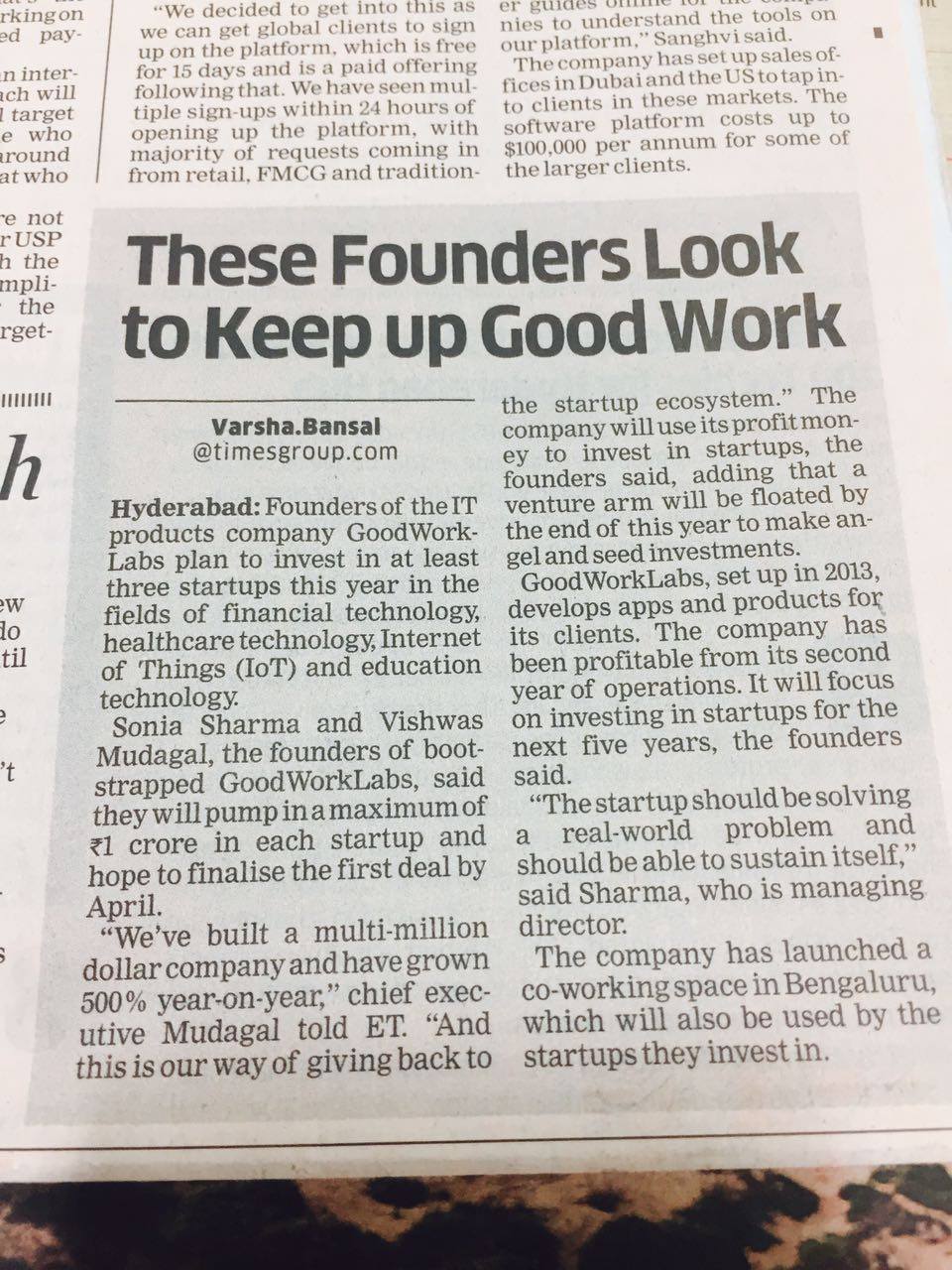
Our Founders, Sonia Sharma and Vishwas Mudagal recently caught up with the Economic Times to announce the big news that in 2017 this entrepreneurial duo are all set to invest in 3 Startups in the field of Financial technology, Healthcare technology, Internet of Things, Education technology.  The seed funding will amount to anywhere between 25 lakhs to 1 Crore INR.


Goodworklabs economic times


After having built a successful multi-million dollar company such as GoodWorkLabs, both Sonia and Vishwas are all set to support the growth of Startups in the technology sector. Their recent venture – GoodWorks CoWork is also aimed at providing the perfect ecosystem required for their growth. Right from office space to community building and mentorship, GoodWorks CoWork is all set to become the breeding ground for Startups in Bangalore.


GoodWorks Cowork


“We have built a multi-million dollar company and have grown 500% year-on-year and this is our way of giving back to the startup ecosystem”  Vishwas Mudagal ,CEO of GoodWorkLabs, told Economic Times.

GoodWorkLabs, set up in 2013, develops mobile apps and products for its clients. The company has been profitable from its second year of operations and will now be using these profits to invest in Startups for the next 5 years.

“The Startup should be solving a real-world problem and should be able to sustain itself” said Sonia Sharma who is the MD of GoodWorkLabs.

Together, they both are super excited about their new journey as Angel Investors and also about their CoWorking business venture and we wish them the best for the journey ahead!


GoodWorkLabs becomes a Google Certified Agency

GoodWorkLabs is now a Google Certified Agency


GoodWorkLabs is very proud to announce that Google has certified us as an expert agency that understands and excels at building Android applications. We are one of the first few companies in 2017 to make it to Google’s Android Certified Agencies list across India, UK, Russia, Indonesia, USA and Canada.


Google certified agency


As a leading Outsourced Product Development Company and UX design studio, we know what it takes to build a mobile application that can spur millions of downloads from the Play store. Attention to detail, User Interactions, Design and Graphics, we ensure we build the best technology for our clients that will scale up their business.


GoodWorkLabs is one of the top 25 Google Certified Agencies: 

As part of this Developer Certification program, Google recognizes only a hand-full of organizations that have undergone the required training and have demonstrated expertise in building exceptional Android applications. By bagging this prestigious title, GoodWorkLabs has proven its excellence in terms of Android technology, design and mobile apps as a whole.

Here is the list of top Google certified agencies:

“This is by far the biggest recognition in the global industry that GoodWorkLabs is the leading company when it comes to building Android applications and related technologies. Google Certification has put us on the map of the best of the best agencies in the world,” said Vishwas Mudagal, CEO and Co-Founder at GoodWorkLabs. “Having bagged this certification, our credibility has gone up many notches higher, which in turn has resulted in increased confidence in our capabilities by our growing customer base across geographies.”

This certification will also help clients make a more informed decision while looking for an agency to build Android apps. In the past, we have worked with some of the top clientele which include both funded Startups and Fortune 500 companies.

Sonia Sharma, Founder and MD at GoodWorkLabs, said, “There is no bigger certification authority than Google for an agency. Years of effort in perfecting UX, design and technology, and a vision to build apps that touch the lives of millions of users have brought us here today.”

The benefits of becoming a certified Google developer agency are plenty, some of which include personalized training, priority support, dedicated content, and access to Google’s developer relations teams. Certified Agencies will also get early access to upcoming developer products and will get help with UX reviews.

GoodWorkLabs is delighted to be part of an ecosystem that understands and excels at building Android technologies.

How Virtual Reality Can Impact the Gaming Industry

Even a few years ago, the very idea of simulated three-dimensional worlds that you viewed through those special goggles appeared to be unfamiliar. But, today things are no longer the same. Virtual Reality has gone mainstream and is increasingly adopted today to bring about a competitive edge and win over customers with tremendous audio-visual impact. For instance TechViz states that 171 million people globally could be using VR hardware and software by 2018. Another stat from Digi-Capital states that the 2020 VR revenue forecast stands at $120 billion.

Changing trends in Virtual Reality

So, how are things different from before? In fact, Hollywood has been using the concept of virtual reality for several decades now. The technology sector has been also creating prototypes every now and then. But, what makes things interesting is that consumers can now expect to find high-tech virtual reality gadgets getting closer to the consumer products. The applications based on VR are rapidly emerging in the market. Gaming based on VR does not exist in isolation but is interconnected with latest technologies and social behavior. The synergy between all these fields can change the way you will experience situations and your behavior.

How_Virtual-Reality_Is_Going_To_Change_the_Gaming_Industry

It has also enabled the game developers to design new and interesting gaming experiences. The experiences include online casinos using VR technologies big time, which is extremely popular. Here are some of the ways Virtual Reality can change the gaming experience.

Synergy between collaborating gaming scenarios and social experiences

Virtual reality can create social experiences even while gaming. The person who uses the virtual reality headset can only view the various virtualized elements. This can be also regarded as a piece of the puzzle where the individual who can view the elements needs to communicate the same to the other team members. The job of the team then is to conclude what is the thing to do thereafter.

VR enables greater involvement among the players

Players are more involved when the gaming is based on VR, equipping them with a higher number of tools at their disposal as compared to the flat-screen gaming. While flat-screen gaming does have the capacity to make the players feel emotional to some extent, it does not match up to a VR gaming experience where the players feel as if everything is happening in reality. The players seem to feel that they are witnesses to the events and they are responsible for those scenes. Though earlier games had also done it to some extent, VR gives the players more tools in their hands.

Everything that is unthinkable of in reality is possible in VR 

Virtual reality can make the players feel as if they belong to a scene rather than simply demonstrating things. The simulation enables the players to see things from a different angle. They can witness the experiences of other people, which was something unheard of even some years back.

Thus, the VR technology can create an interesting world of vivid imagination while shattering the scope of traditional education and learning.

How Machine Learning will Decide Which IoT Trends Will Survive

The growth of IoT is fueled by the fact that there are more than 6 billion IoT devices in use, and is successfully connecting humans and devices with every passing day. From automatic air purifiers and scheduling hospital beds based on the merit of physical condition, to finding misplaced objects, we have it all. These devices do not come easy; it requires machine learning which programs it to be what we get today.

How machine learning will decide which IoT trends will survive

The ‘things’

Qardio Arm a wireless blood pressure monitor which has left behind the regular monitor is an example how machine learning can bring about change in IoT. With the help of cloud, this machine can store the readings of the patient on cloud and be shared with the doctors digitally. Such products make IoT survive in the market due to its performance enhanced due to machine learning, not just this it opens up a market for the product and increases sale.

Another startup, Zenatix, manufactures and installs smart meters and sensors to reduce energy wastage through monitoring of the devices at every level, using its cloud technology.

Machine learning will keep you going

Just detecting impure air or Fitbit monitoring exercise patterns, isn’t enough. Consumers (especially B2B consumers) want to have deeper level of value from IoT.

This is exactly where machine learning comes in.

Machine learning which will include big data sets, larger algorithms, pattern recognition, image processing and data mining bring greater chances of improving the device.  Through machine learning algorithms and data, now devices can sense a person’s mood or behavior. This will help them to adjust to their requirements and hence provide ‘smart’ value as a part of its convenience and comfort offerings.

Google’s Nest is one such which has made ‘smart’ device indeed a smart one with its cutting edge technology and makes people’s home a smart home.

Race to top

There are many IoT companies but only a few have what it takes to survive this market. With Innovations being made every day the companies have to keep up and make their devices top notch and make improvements to stay in the running.

With this, there is the development of the device that makes the consumer happy not just to have a useful device but a powerful one.

Machine learning which makes the product powerful and has other benefits to the consumer such as cost reduction and not having to buy many smart devices to make one smart device work makes it stay in the IoT industry.

Everyone can be winners

IoT startups have a bright future with several companies who are looking to make investments which are lending their machine learning knowledge to make worthy and smart devices. Cisco Investments are infusing more than $150 million globally in IoT startups. This is a clear indicator that IoT devices from all over the world can get funding and the necessary hardware for making machine learning possible even if it is a small startup with limited capital.

Like they say, things should change with the change in times or be left behind, which is very appropriate in the world of IoT which can be overcome by machine learning.

Carer Program | A Cancer Rehabilitation Program

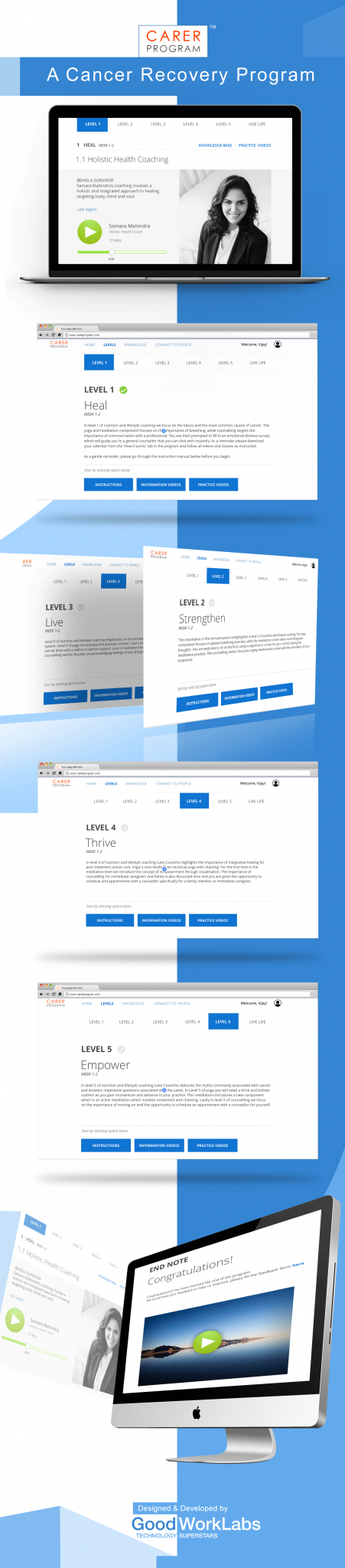
Carer Program is India’s first and only provider of integrative cancer care that helps manage the cancer journey. They specialise in protocols in the areas of nutrition, mental well-being, and movement & mediation. They take care of the patient’s recovery and rehabilitation during and post-cancer treatment.


How did GoodWorkLabs help Carer Program excel? 

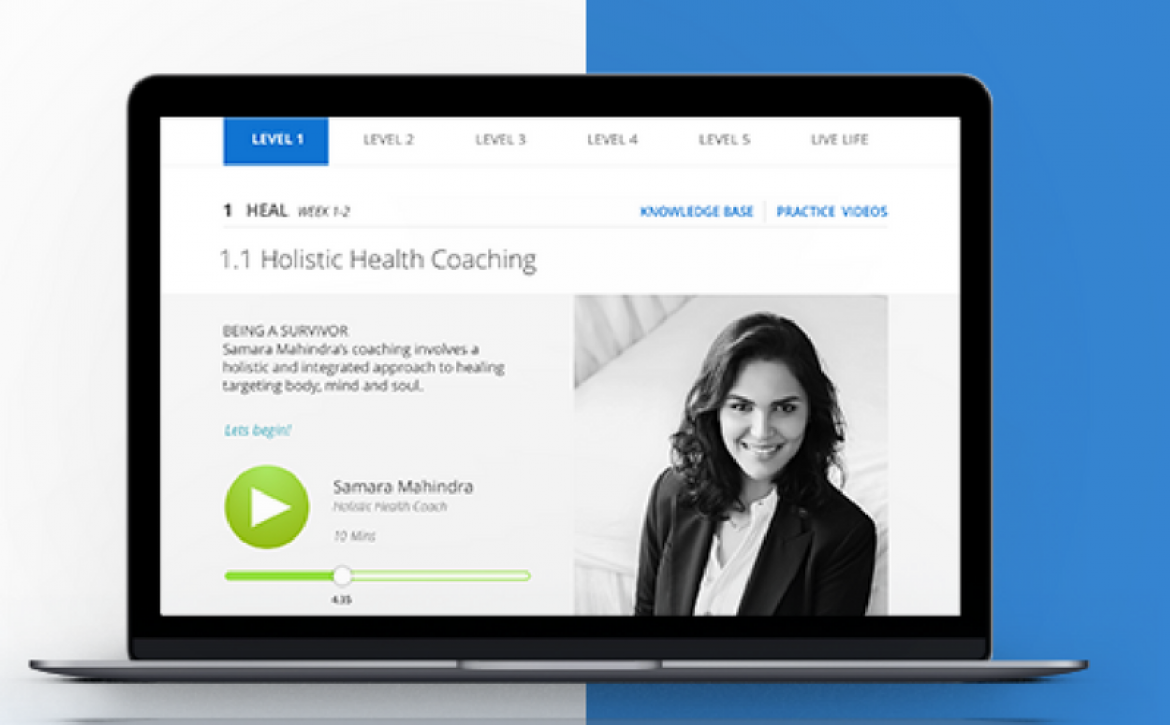
GoodWorkLabs is a futuristic tech development company in India, US, and Europe with their expertise in web development, AI & ML, mobile app development, software development, AR & VR, etc. GoodWorkLabs comes with immense experience in developing effective and state-of-the-art technology solutions. The experienced and agile team at GoodWorkLabs helped Carer Program develop an interactive web application with a great UI UX design. The team used agile software methodologies to build the complete platform online.

The design team at GoodWorkLabs believes that a great user experience lies in the details of the web application. Upon conducting in-depth research, the team at GoodWorkLabs took note of the minute details such as the use of color codes, fonts, background textures, etc. This helped them develop a design that strikes an instant connection with the user. With the help of lean UX methodologies, GoodWorkLabs built a web application with excellent user interaction for Carer Program. GoodWorkLabs team takes pride in developing a soothing and easily navigatable web application for Carer Program.


Client Testimonial

We caught up with Samara Mahindra, the Founder of the Carer Program, and in this video, she shares her experience of working with GoodWorkLabs on the design and technology for the web application of the Carer Program.

What were the salient features of this web application? 

  • Neat and easy-to-use visual design and language
  • Customised content for doctors, caregivers, and patients
  • Different levels of carer programme or chart that doctors, caregivers, and patients can follow
  • Plans and packages were made available online for patients to buy


What were the achievements of this web app development?

  • An engaging platform for caregivers, patients, and doctors
  • 100+ oncologists
  • 1000+ patients and caregivers


Technologies used:

  • Ruby on Rails
  • HTML
  • JS


carer program design

Ready to start building your next technology project?